Last month marked a year since I began the process of giving some of my land a rest. 12 acres were taken out of intensive agriculture for some much needed R&R, and to let nature take control — almost. One year on: no herbicides, no pesticides, no fertilisers, no grazing livestock, just 12 acres of tired ground handed back to itself. The change has been gentle, but unmistakable.
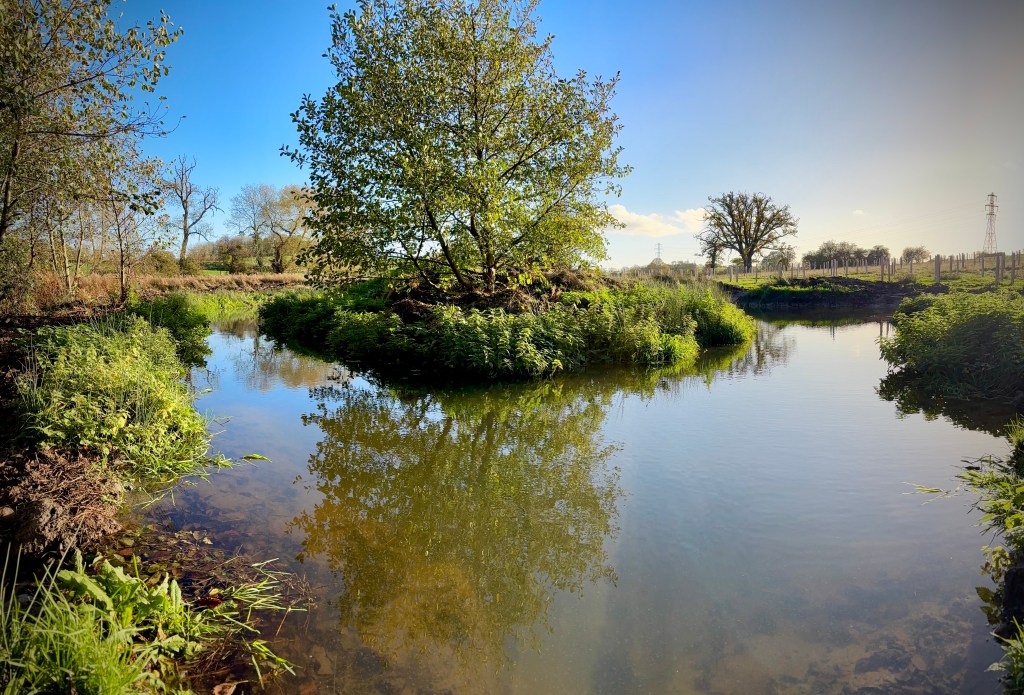
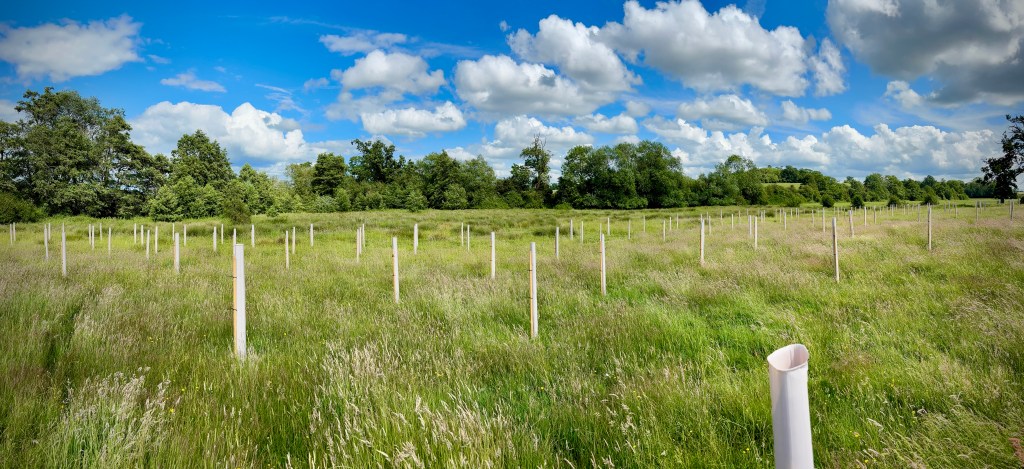
A wide variety of trees, all native to the area and the wider “foggy Albion”, have been planted — approximately 3,250. I’ve created two ponds; one simply a marshy groundwater affair that will rise and fall with the seasons, and the other a larger spring-fed body of water with an island and scrapes, that overflows into the brook — the piped spring’s destination, prior to me digging the pond.
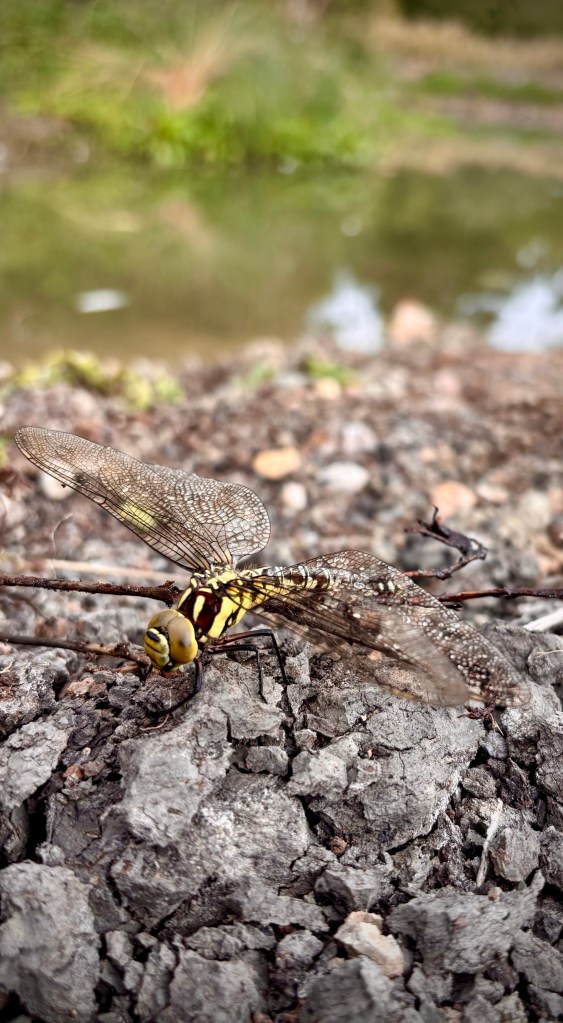
The ponds have been a pleasant success, and a gift that keeps giving. These newly created bodies of water now pulse with life; hoverflies, pond-skaters, beetles, water boatmen and a constant shimmer of wings, rapid movement and surface-dwelling larvae. In the summer, I couldn’t walk near the water without marvelling at an abundance of damselflies and dragonflies hovering over the surface and zooming around the edges, looking very much at home.
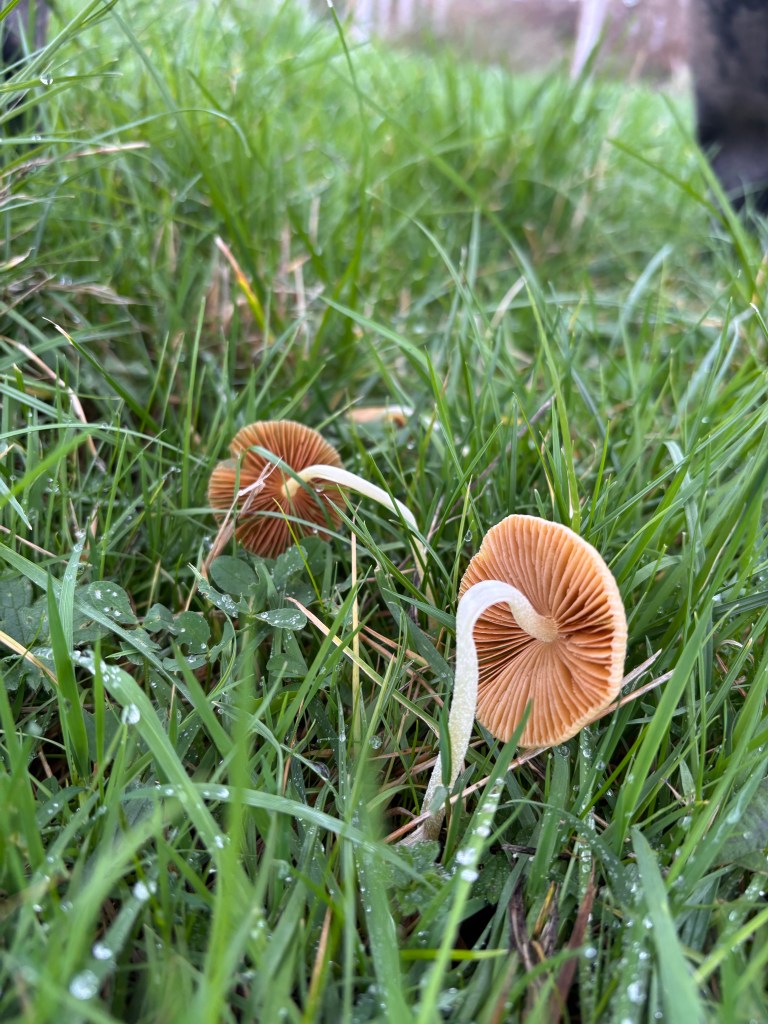
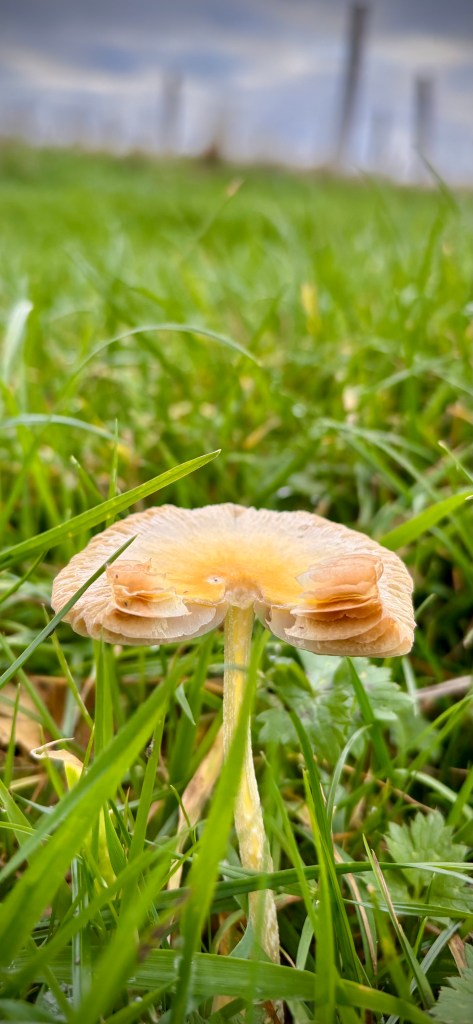
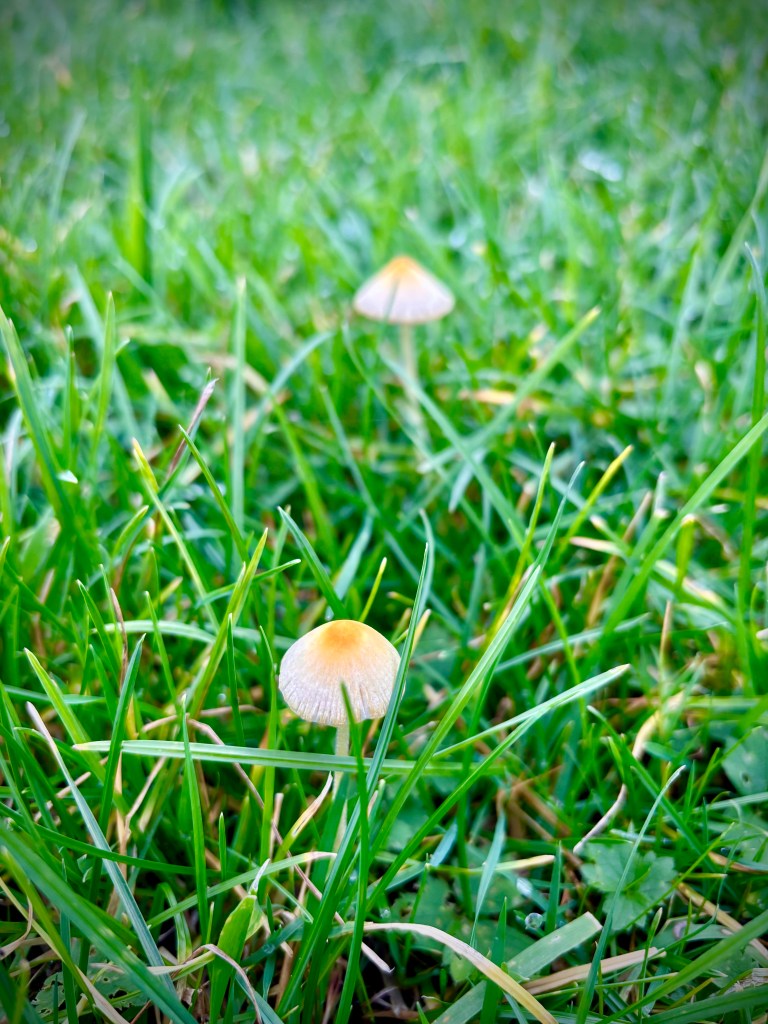
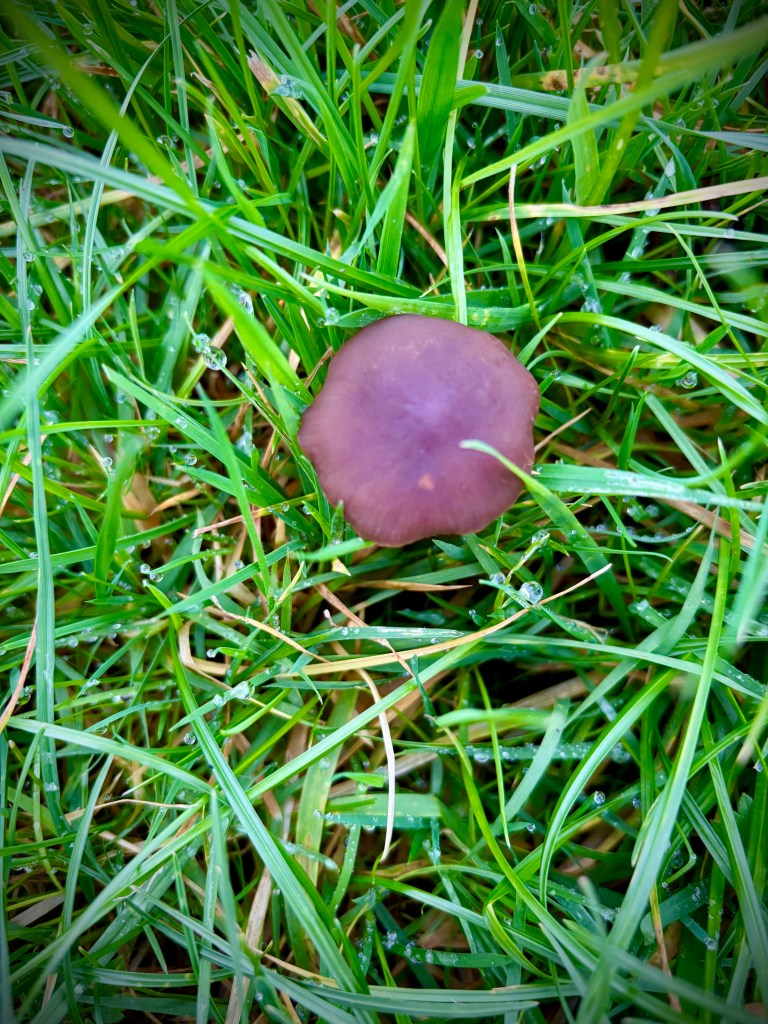
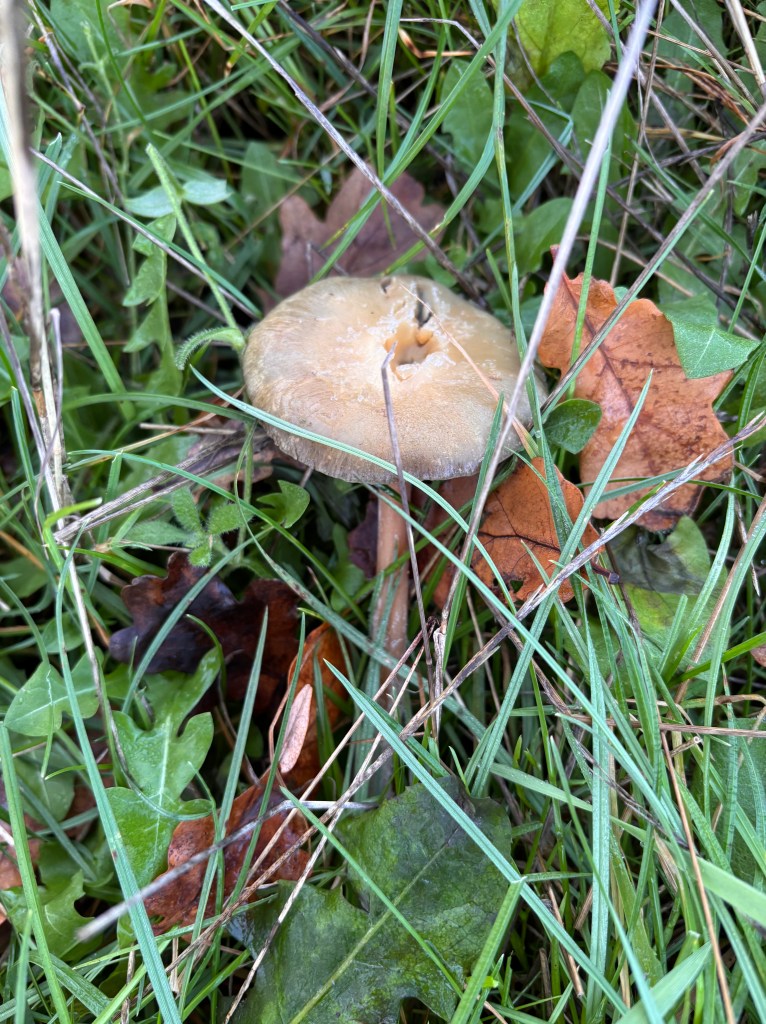
The most striking thing I noticed this autumn was the mushrooms. Not just one kind, but many — thin-stemmed bonnets, inkcaps, tiny conecaps, glossy dark-capped species and more, tucked between blades of grass and in small colonies. A variety of shapes and sizes, all fragile, and all signalling the same thing: the fungal network is returning.
Fungi are apparently one of the earliest responders when chemicals are removed from the equation and soil is allowed to heal. They break down old roots, recycle nutrients, and create the living foundation that future woodland depends on. These little mushrooms are, I hope, the beginning of a much longer story.
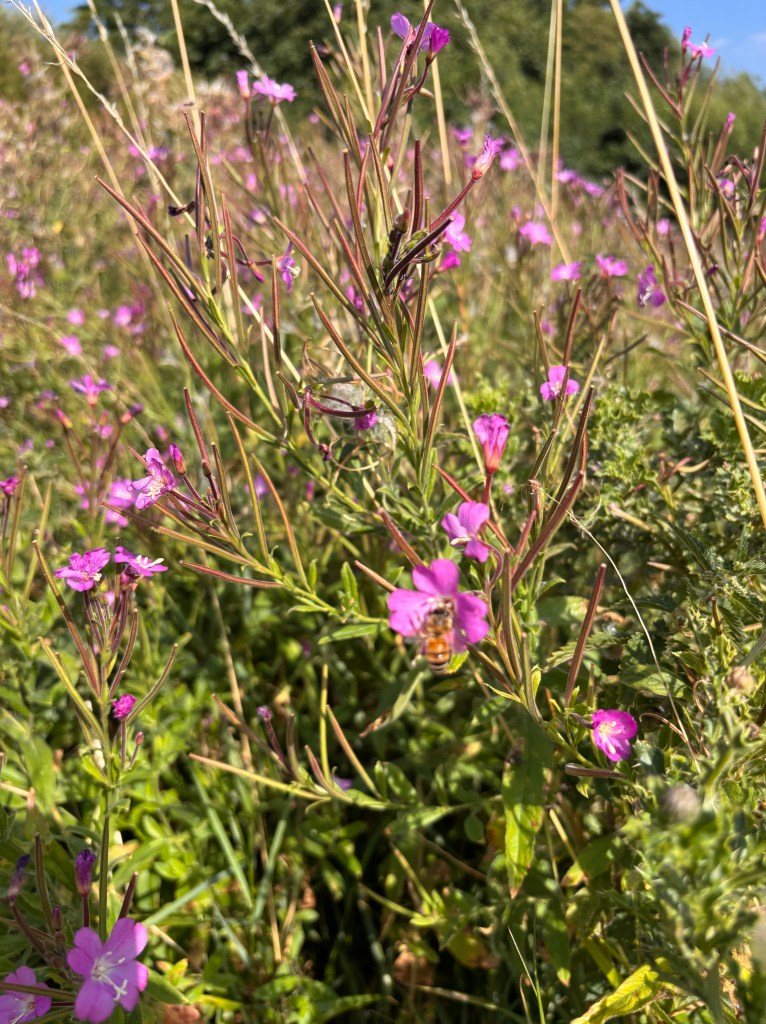
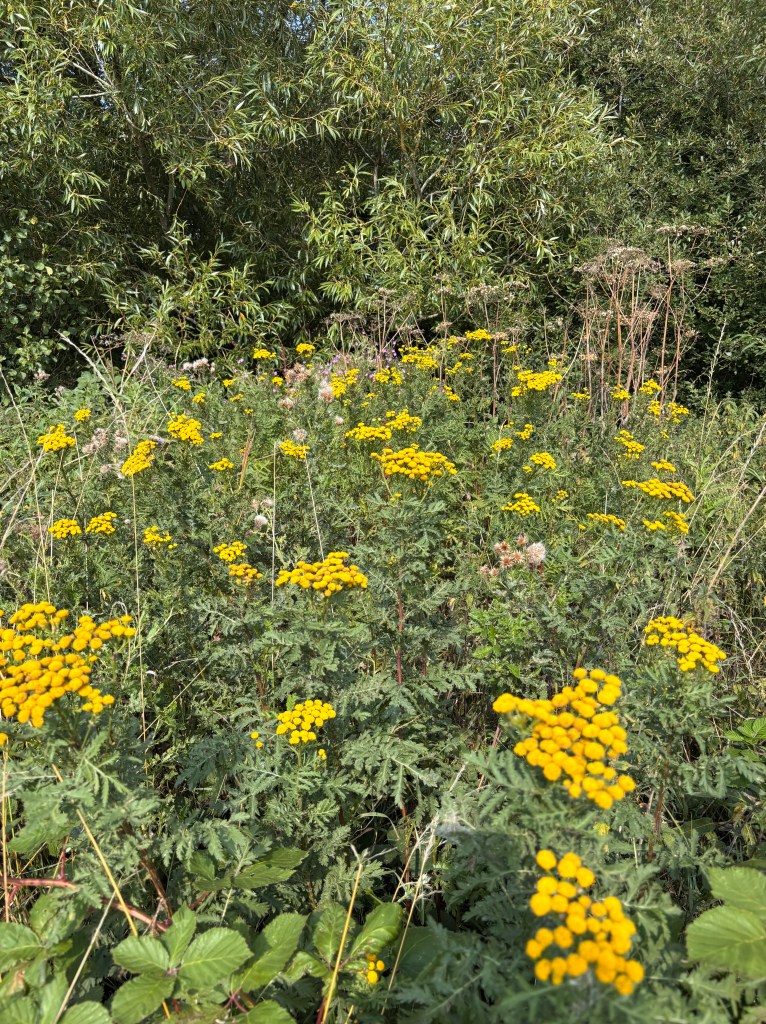
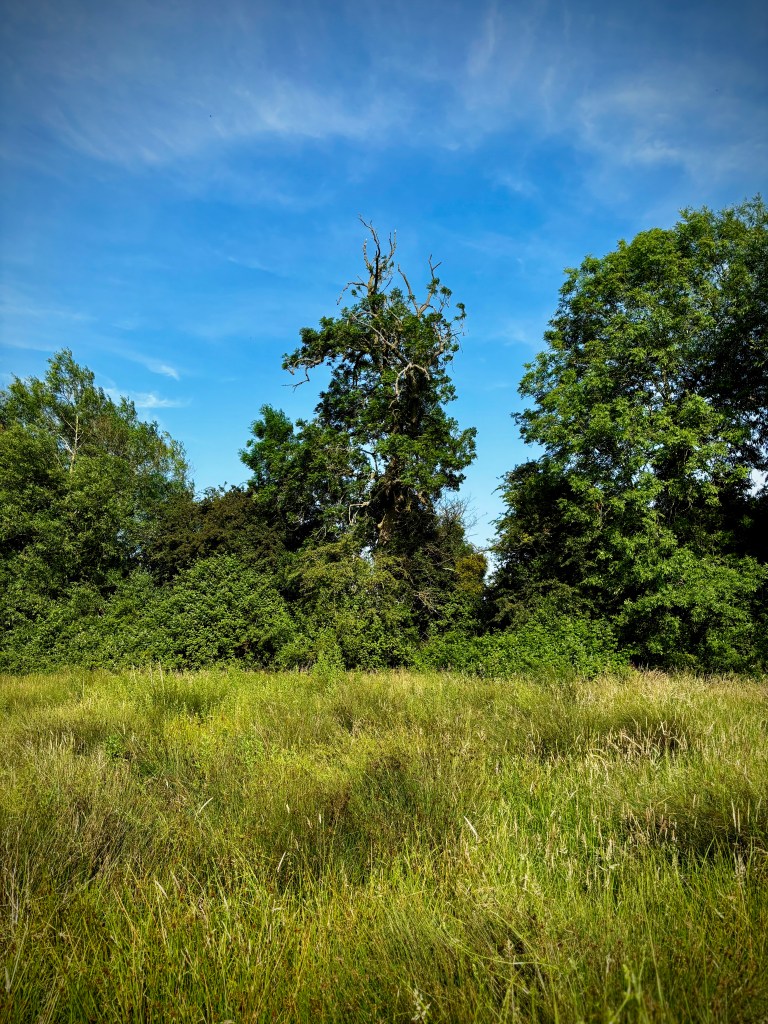
Long grass, no longer shortened by hay and silage harvesting or livestock grazing, was alive with moths and butterflies in the summer and has become cover for rabbits, and a small group of roe deer — whose presence is a bit of a double-edged sword with regard to the new trees. Their grazing is light, natural, and part of the ecological rhythm, rather than the pressure of cattle and sheep grazing. The whole site feels less like land being managed and more like land simply being. Nature cams have picked up badgers and foxes, pheasants from a local shoot — unwittingly finding sanctuary — and an occasional muntjac between roe.
This is only the first year. A woodland takes decades to mature, and a vibrant, fully functioning ecosystem even longer still. However, standing in the wet grass, watching mushrooms push up through soil that once looked exhausted, I can’t help but feel encouraged and optimistic. These are early signs and few — but they are real signs.
This is the first year of stepping back and listening. The first year of trusting that nature knows what’s best.
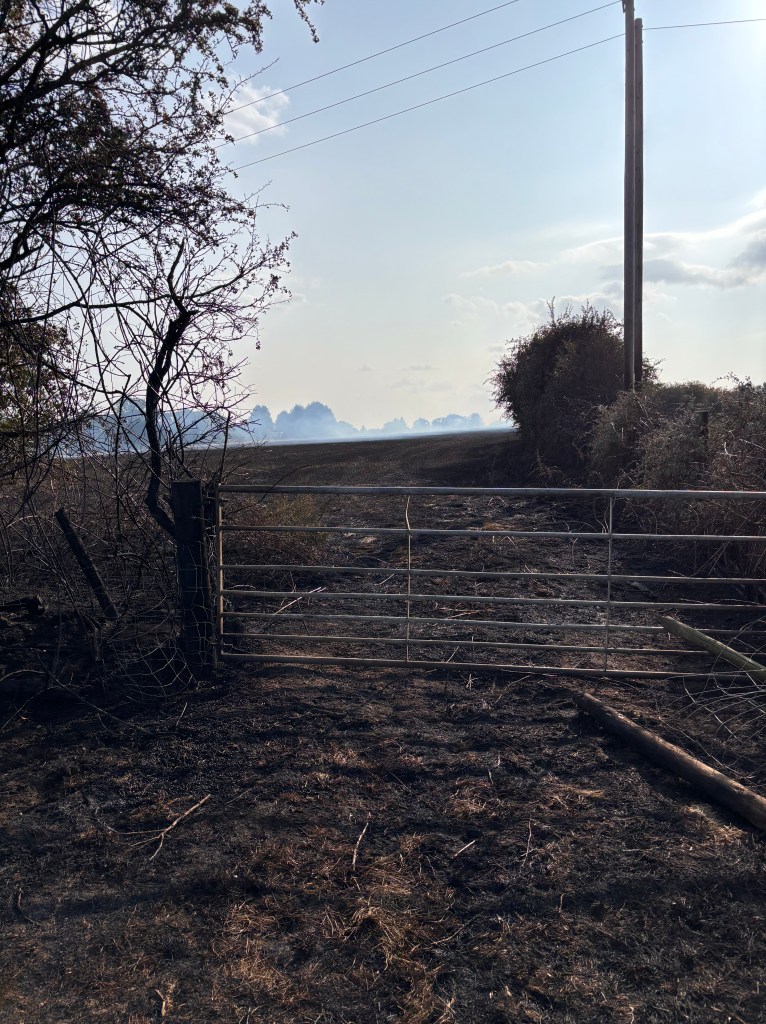
Yesterday afternoon, the air above my usually quiet bit of the British countryside was thick with smokey fog of burning vegetation.
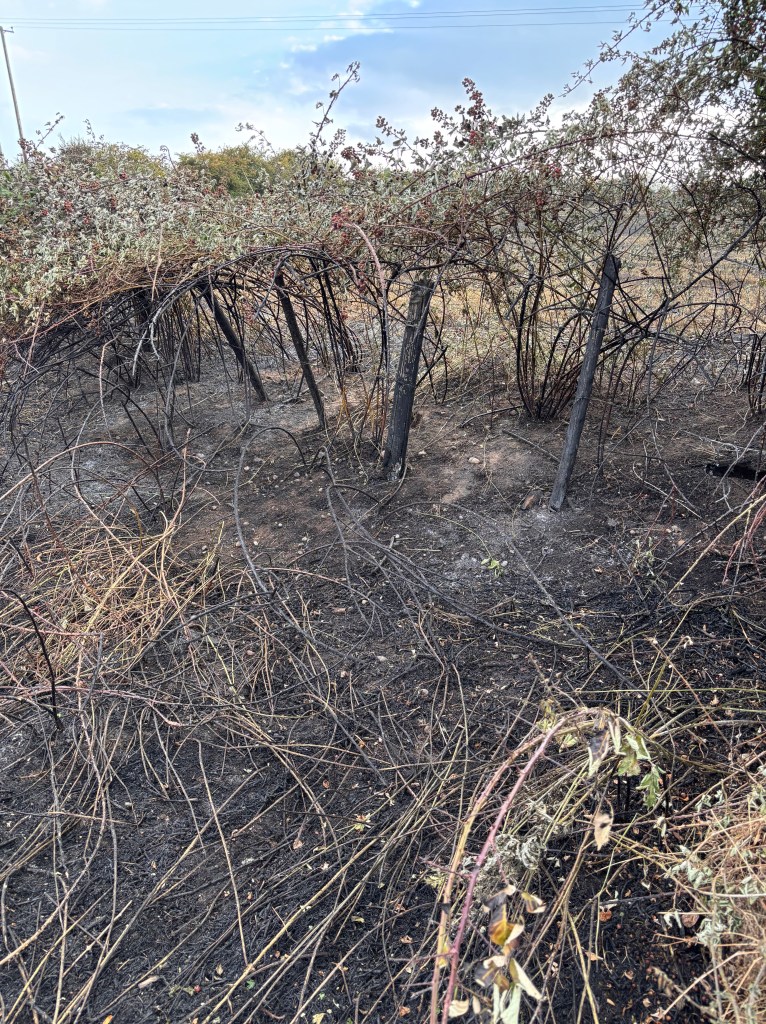
A field fire that roared rapidly across the parched remnants of a recent wheat and hay harvest, consumed first stubble, then hedgerow, and fencing followed. In the now uncomfortably regular season of wildfires across the world, particularly the Northern Hemisphere, this one was small beer. But, it gave me an unpleasant, though tiny, taste of what it feels like to experience a wildfire.
Currently, the best guess as to the cause of the fire is a muck heap that might have spontaneously combusted due to the relentlessly dry weather – July was the driest since 1976 in Worcestershire, apparently. Fed by these bone-dry conditions and the fact we’ve had no meaningful rain for weeks, even months, the fire spread rapidly – fanned by a strong breeze. In no time at all, it escalated from ignition through wheat stubble, to garden, to hedge, to hay stubble and beyond. At one point, worryingly close to a neighbour’s house.
The smell of charred grass and scorched earth filled the air. The neighbour, whose house was most at risk, called me, knowing I was further down the fields preparing for the second stage of pond digging. Leaping over a fence and running the most direct route to the top, to unlock gates for the fire brigade, within minutes the same route I’d taken was engulfed in flames. My main concerns were another neighbour’s horses, into whose territory the fire was in danger of spreading, and eventually did, and a small group of a dozen uninvited migrant sheep on my land. Try as I might, I couldn’t get the infuriating creatures to exit the way I assumed they had arrived.
Huge credit to the men and women of the Hereford and Worcester Fire and Rescue Service (HWFR). Within minutes the first fire engines had arrived. Realising the potential of what they were faced with, they quickly drafted in extra help. Fire engines and a water tanker came from Worcester, Bromyard, Droitwich and Birmingham. As each engine emptied its load, they pulled out of the fields and refilled from a mains connection across the main road, in the village.
By 19:30, and with the help of the tenant farmer’s tele handler with a large bucket to spread the muck heap, the crews had beaten the blaze; their thermal imaging scanners only picking up the occasional fence post with a stubborn flame. They sent a crew back at about 22:30 to do a final check.
There are now acres of black in place of golden stubble. The hedges blackened and cleared of scrub. In a way, it was reminiscent of my early years, when stubble burning was still acceptable practice (banned in the early nineties I believe). Back then, the headlands would all be ploughed to create a natural barrier and fire break. Yesterday’s uncontrolled blaze, instead of extending as far as ploughed earth and stopping, met hedges, tinder-dry and ready to fry.
Walking across the land for a final check last night, before heading back to Herefordshire, I noticed a rabbit hopping gingerly between the charred remains, below the scorched hedges. The horses and itinerant sheep got through it with nothing more than a bit of stress, but I can’t help feeling there were many smaller casualties that will go unnoticed.
My experience using the Ghillie’s lightweight, British-made, Adventurer Kettle Cook Kit
* Note: Review based on my personal experience with the Ghillie 1L Adventurer Kettle & Cook Kit. I’ve not been sponsored or paid by the manufacturer to write this post, and have had no communication with them. I purchased the product myself. I just like to shout about products that I am genuinely happy to have bought.
There’s something truly satisfying, even soothing, about being able to brew a mug of tea in the open. Recently I set up camp in my newly planted woodland to spend some time with digger and dumper, creating a wetland. Well, it’s now more of a pool-and-rewinding project, but more on that in a future post. Given the recent drought and abundance of dry grass, I needed a safer portable camp cooking kit option, rather than an open fire for heating food and water.
Enter from stage left, the Ghillie 1L Adventurer Kettle and Cook Kit. An exhaustive search online, actually about two minutes, and I found something that ticked several boxes: easy to use, convenient, light, preferably made in Britain (or failing that as close as possible).
Based on the old volcano kettles, Ghillie kettles are made just up the road in Birmingham, by hand, using time-honoured techniques. Lightweight body made from aluminium and spun on a lathe – simple and sturdy.
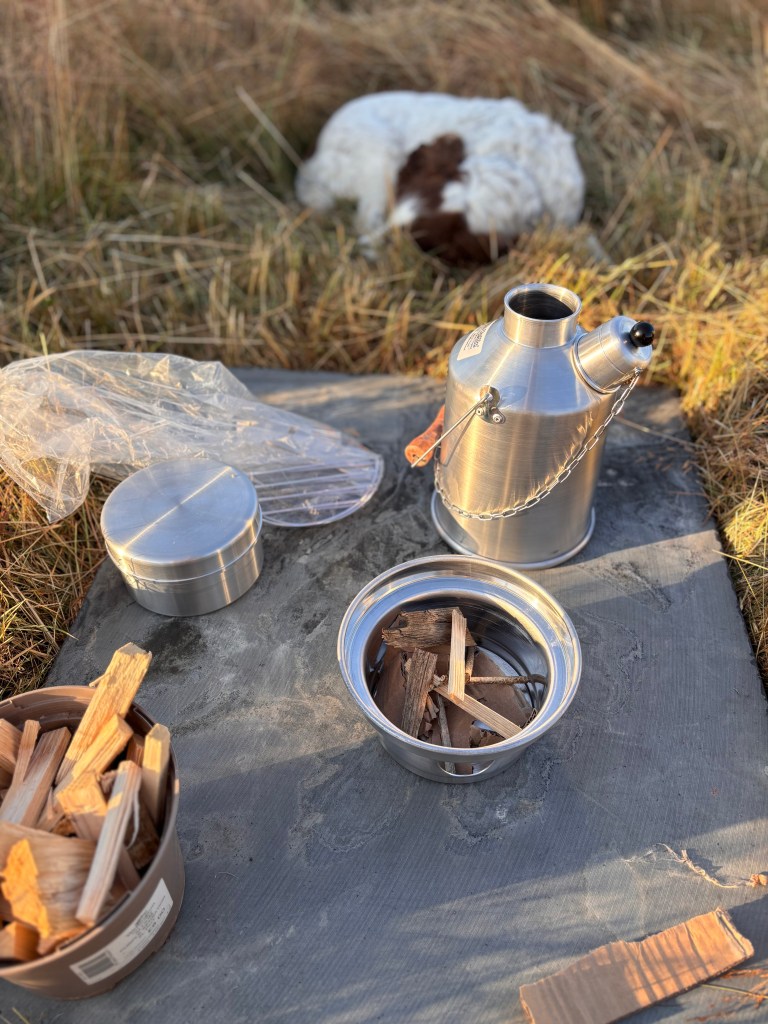
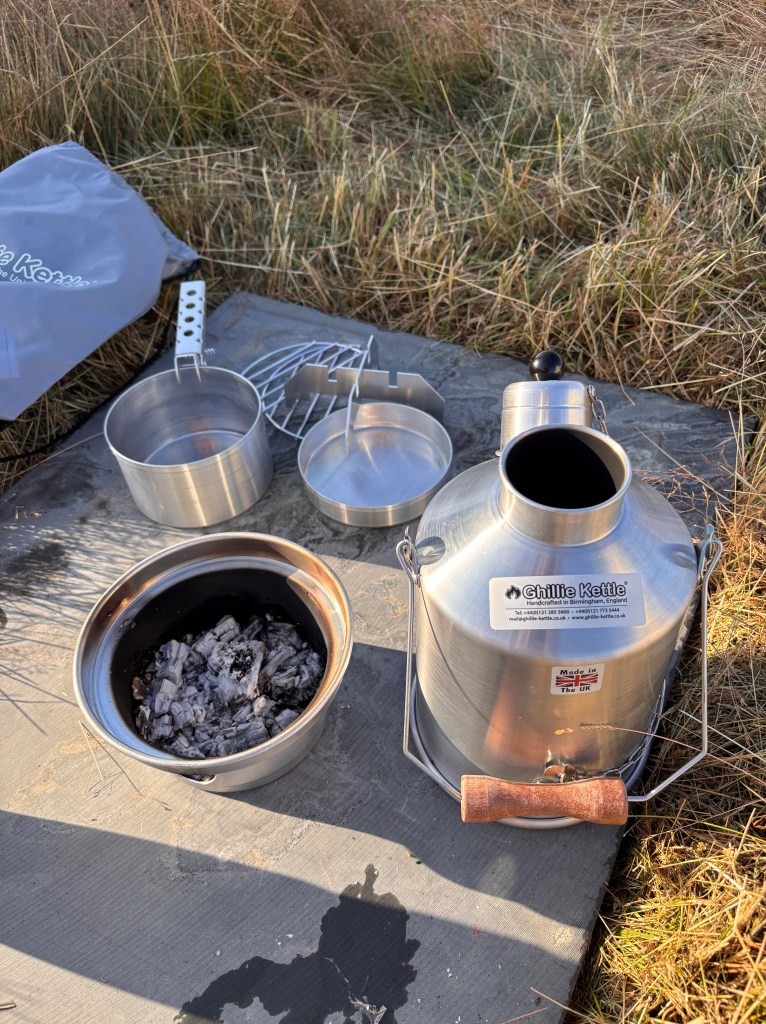
I opted for the adventurer cook kit: Ghillie Kettle, saucepan and frying pan, grill rack, pot handle and pot stand. There should also have had a triangular base support, but that didn’t arrive with my kit – not a problem though.
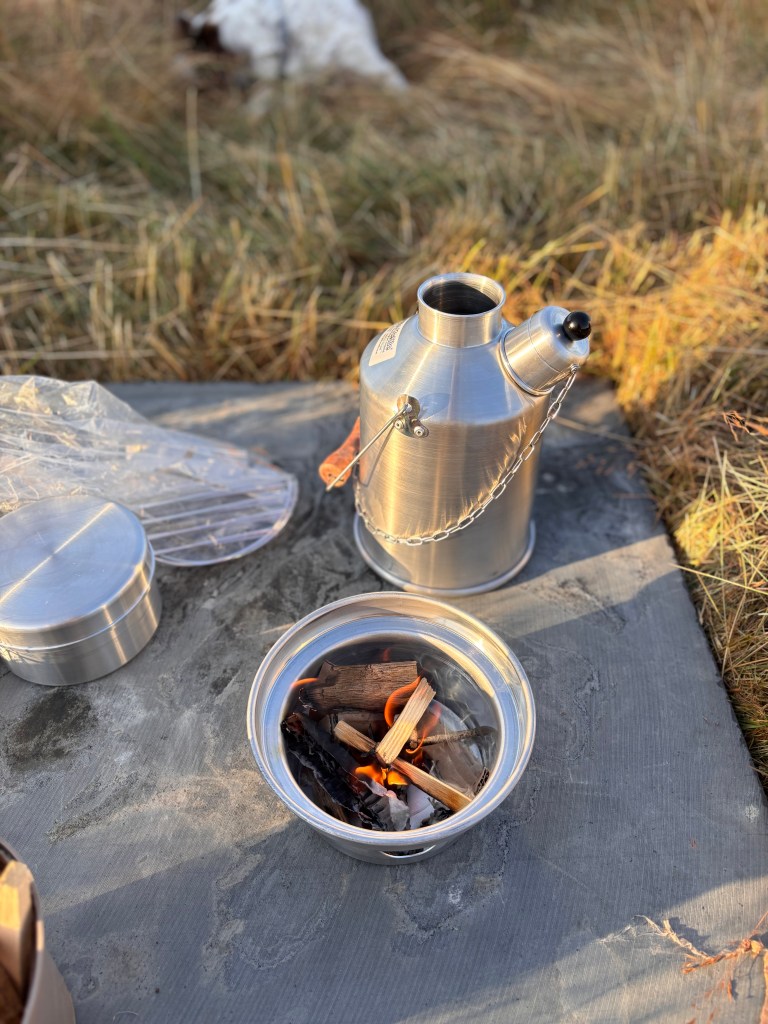
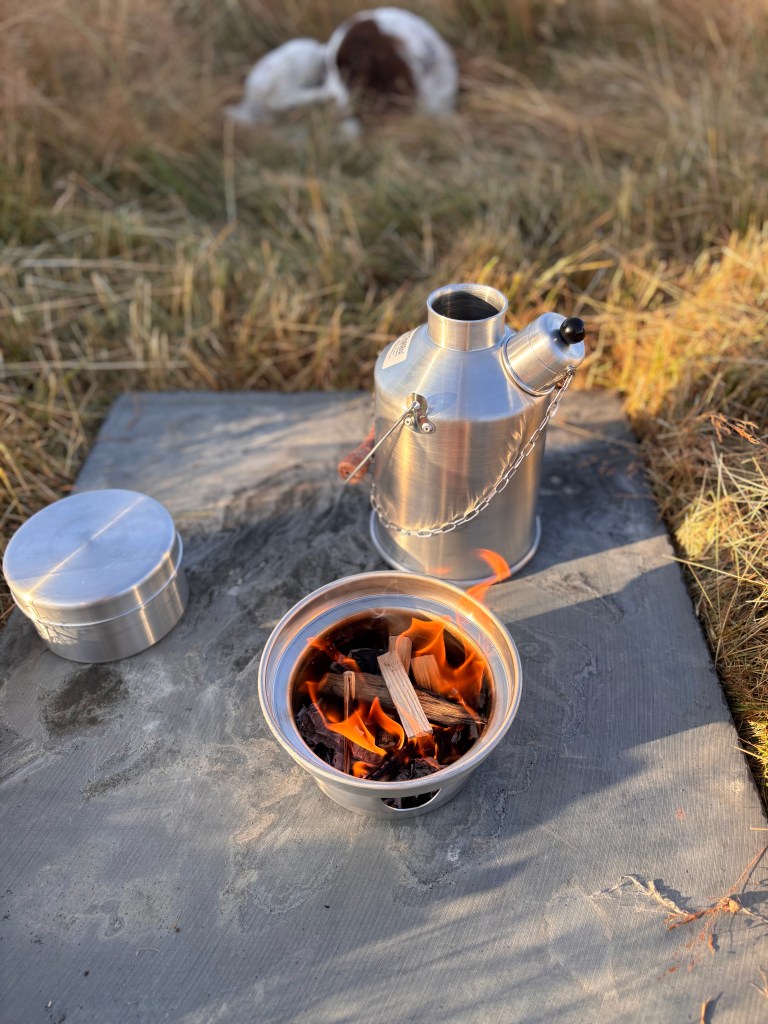
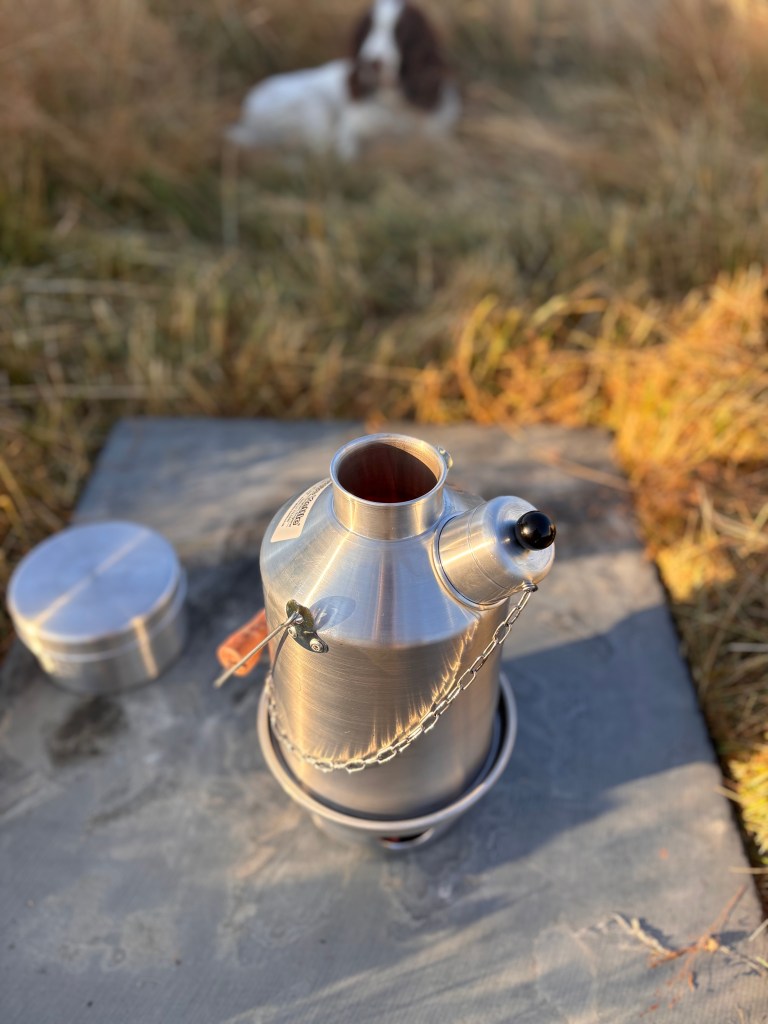
The Ghillie website states that this kettle will boil water for a couple of brews in minutes. I assumed this was usual manufacturer hyperbole and a gross exaggeration. However, I was more than pleasantly surprised. Lighting a fire in the base was easy. Once a little bonfire was roaring away, I placed the kettle on top and within two minutes the whistle sounded loudly and there was enough boiling water for my morning brew and my thermos mug.
Later, I tried warming some food in the saucepan on top, whilst boiling more water. Worked a treat. I haven’t tried the grill yet, but given the way everything else works, I don’t think it will disappoint.
This really is a cracking bit of kit and well worth the money; currently £89.99 for this 1 litre kit from the Ghillie Kettle website. Other options are available. Whilst this is, perhaps, too bulky for a hiking camping trip, it’s certainly a great option when there is a vehicle to carry your equipment. This lightweight camping kettle is strong and, refreshingly, British-made.
It couldn’t be easier to use, it really does do what the manufacturer claims, and it’s easy to clean. It stows neatly away in the Ghillie carry bag, and it also feels quite safe to use – of great importance in our current dry spell.
Have you used something like this? What was your experience? Let me know in the comments below!
The lungs of the planet, important ecological habitats, vertical playgrounds, winter fuel or a canopy for youthful romance; the ever-important trees.
The Sycamore Gap tree is in the news again. After being illegally felled in an act of pointless idiocy and vandalism back in 2023, the two culprits have just been sentenced to 4 years in prison each. This got me thinking about our relationship with trees here in Blighty – and, I’m sure, in many other parts of the world.
Like most of my generation – that’s X since you ask – trees were a source of entertainment and joy whilst growing up. As kids, we didn’t yet have the mesmerising distraction of small screens, the internet and social media. Trees were there for everything; great for hide-and-seek, perfect for climbing, and where better to build a den or treehouse to escape the gaze of adults or from where to take refuge from imagined enemies?
Growing up in the countryside, as I did, trees were like vertical playgrounds littered across the landscape, waiting to be conquered. Repurposed wooden pallets could be hoisted up to create a ready-made platform high above the ground, and a base from which to build a den high up. Ropes slung over branches would be used as a swing. Fallen branches would be crafted into staffs with a trusty pen-knife, thinner ones into arrows and spears – this was the seventies and eighties, a time when the words “health” and “safety” were rarely heard together, or at all.
Trees have held great importance for these islands throughout history. With evidence of occupation going back almost a million years, broken by the occasional pesky ice-age which would, presumably, have destroyed most tree life on the parts of the island these ginormous kilometres-thick ice sheet would have extended to, we can look to more recent history. Assuming that Neanderthals and early Homo-Sapiens made use of what was perhaps an abundance of tree and plant life.
Evidence remains of Mesolithic and Neolithic inhabitants, through to the Beaker people of the copper-age and bronze-age Brits using trees to make tools, shelter and decorations. Celtic Druids of the iron-age had great respect for trees and their importance to humans. The word Druid apparently derived from the Celtic word for oak. Their natural oak groves were places of spiritual importance, for worship, education and knowledge transfer.
Wood, especially oak, became essential in the construction of houses, churches, cathedrals, and boats and then ships. As an island race, we have an affiliation with the sea. The earliest sea-going boat ever found in the world is widely considered to be the Dover Bronze Age Boat, found in Dover in 1992 and estimated to be 3,500 years old. It was made from oak planks.
Fast-forward to the 16th century and Henry VIII’s famous Mary Rose was built largely of oak. Lord Nelson’s iconic HMS Victory, built in 1760 from the timber of 6,000 oaks, not only played a huge part in the Battle of Trafalgar, but it is still in one piece today and remains, officially, a commissioned warship in service – the oldest in the world. It was oak that built the majority of the ships in the British navy, which was the biggest in the world from the 18th to the early 20th century.
The recognisable and much-loved Tudor houses of the sixteen hundreds, many still standing and lived-in today, including my own, were built around oak frames. The floors and furnishings were largely wood, often, but not exclusively, oak. Local car manufacturer Morgan Motor Company even made their cars’ body frames from wood, ash, and still do.
From the earliest shelters of the earliest humans through countless generations who’ve been kept warm by the side of hearths burning dried wood, to Dumbledore’s wand, wood has been part of British life.
The reverence and respect for trees seems as old as the desire to harvest them. Together, in groves and woodland and forest, it’s easy to see why the Druids felt they were of spiritual importance and sacred. Equally, alone trees can be towering, awe-inspiring and atmospheric. It’s not surprising the Japanese practice of shinrin-yoku, or forest bathing, is becoming increasingly popular.
Trees appear throughout our literature, history and legends and hold a special place in our hearts and minds: Enid Blyton’s Magic Faraway Tree in The Enchanted Wood, Hogwarts Whomping Willow, Sherwood Forest, the trees of Tolkien’s Middle-earth, the Hagley wych elm in Worcestershire, the Tolpuddle Martyrs’ Tree and the late Sycamore Gap Tree, to name just a few.
My own personal favourite were stories my late paternal grandmother would tell me as a very young boy during sleepovers about the, re-worked, adventures of Mary Mouse, who lived in one of the great old oaks that lined the bridle path running through part of our farm. I never once heard the conclusion to any of her adventures due to the soft and soothing way these tales were told, which set me to sleep within the opening minutes. But I do remember the tree was of equal importance to the mouse in those tales.
The older I get, the more I appreciate trees and their significance. Traditionally, the trees that line the brook along the my new woodland would be pollarded or harvested periodically for firewood. Now there is no grazing livestock in this section and no seasonal hay making and so, less need to keep things “tidy”.
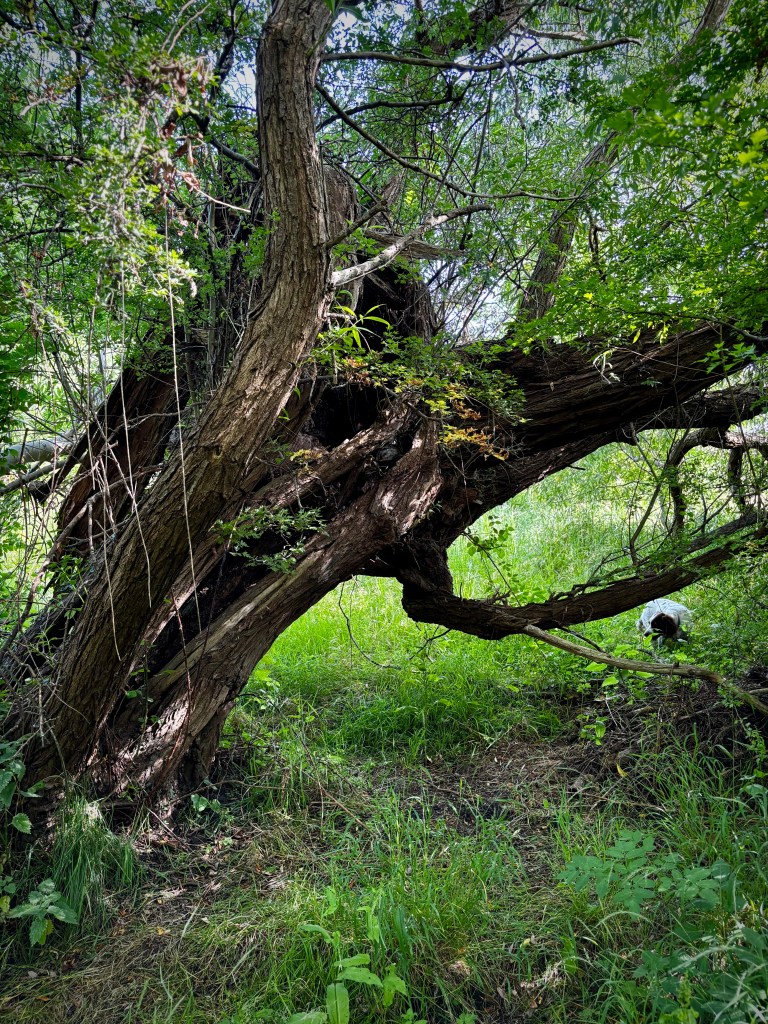
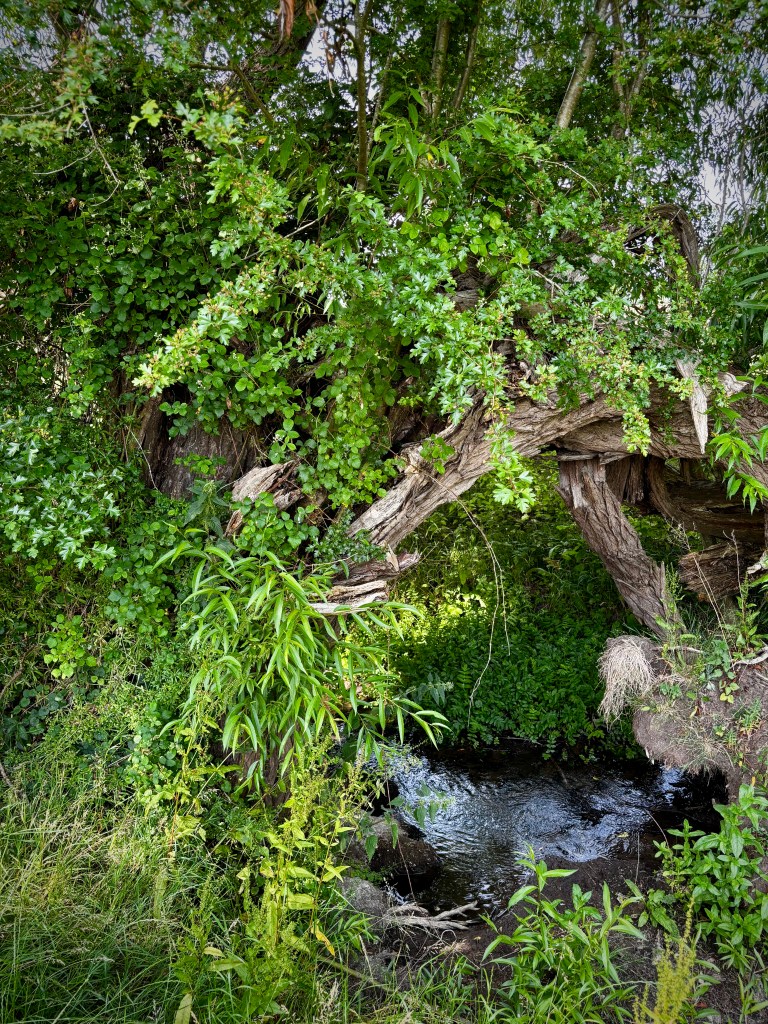
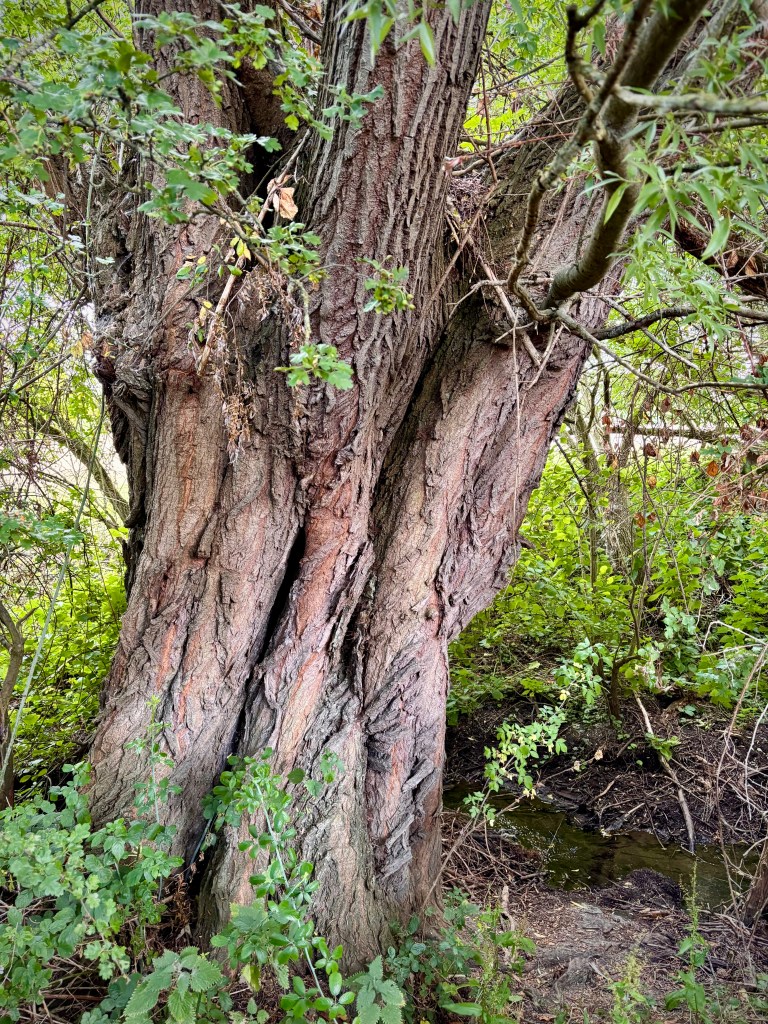
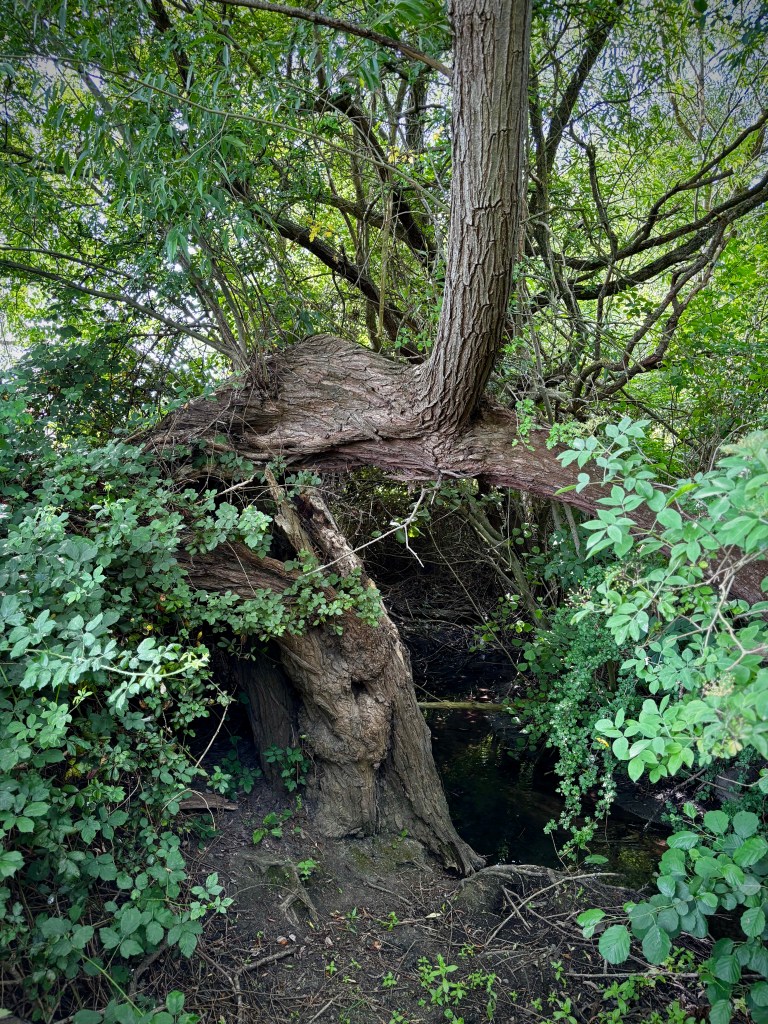
Over recent years, I’ve tended to leave some of the aging trees that have started to give in to the pressures of gravity as they age. As they naturally break down they create all manner of shapes and as they slowly deteriorate they take on life of other forms and become thriving habitats.
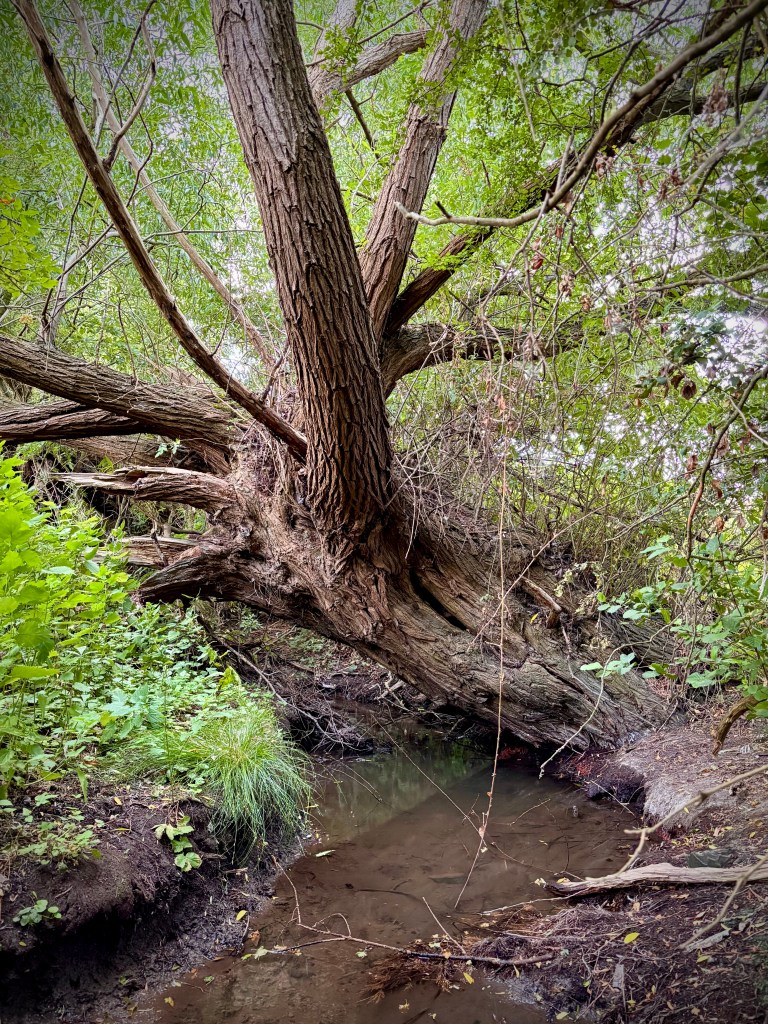
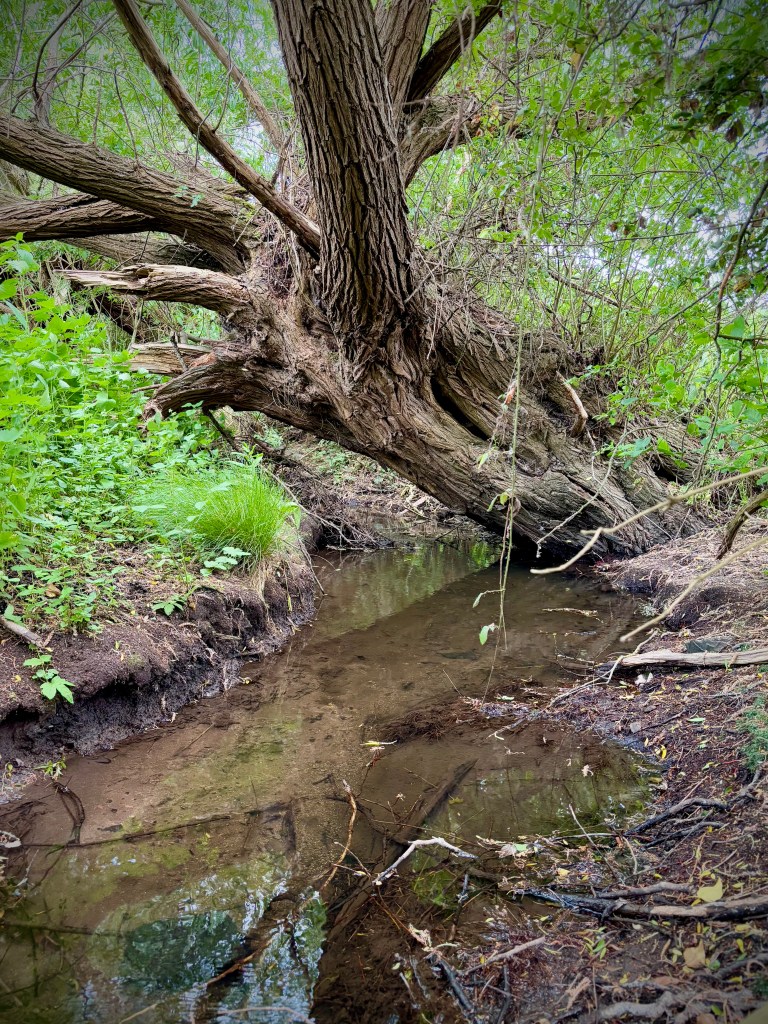
The brook is lined mainly with Salix (Willow) of one sort or another. These fast-growing moisture-loving trees become shape-shifters in their decline, slowly bending and twisting and splitting as they gradually return to the ground. Having resisted the temptation to take the chainsaw to some of these, they now provide a more interesting visual and are, arguably, better for the environment.
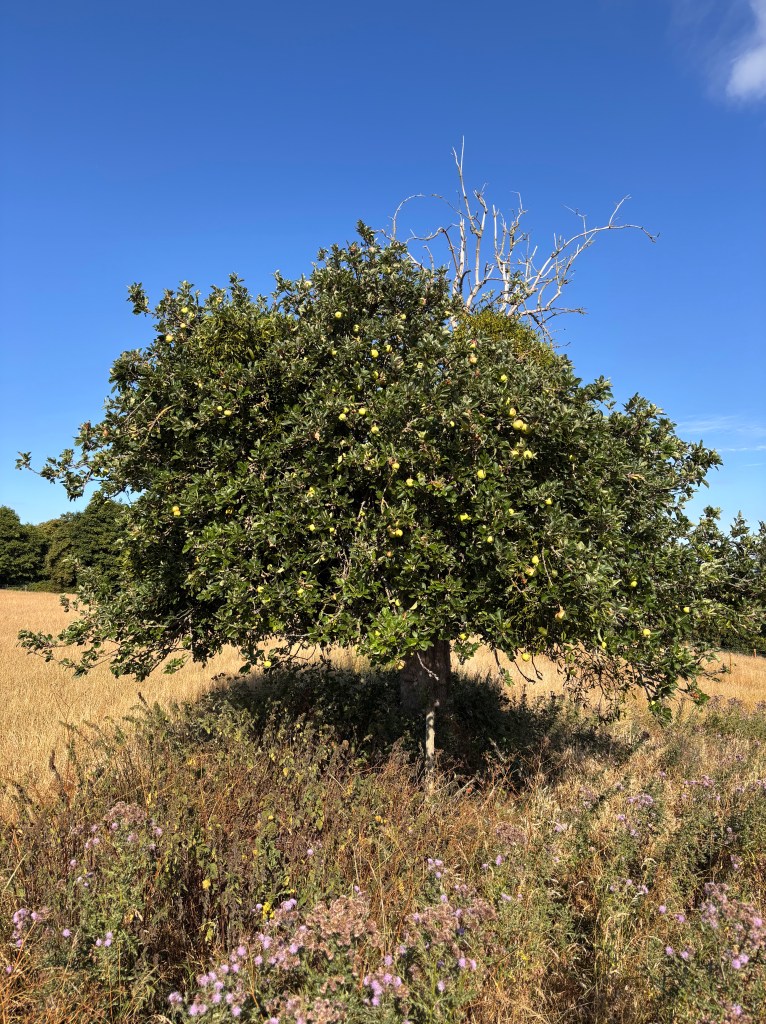
Alone on the highest point of the land is an old crab apple tree. These days, the fruit is usually devoured by birds and insects before I get chance to take anything from it and its aged branches are weighted more with mistletoe than apples – though this year I might be lucky. The trunk is almost completely hollow and a recent investigation by an ecologist found it to be home to bats.
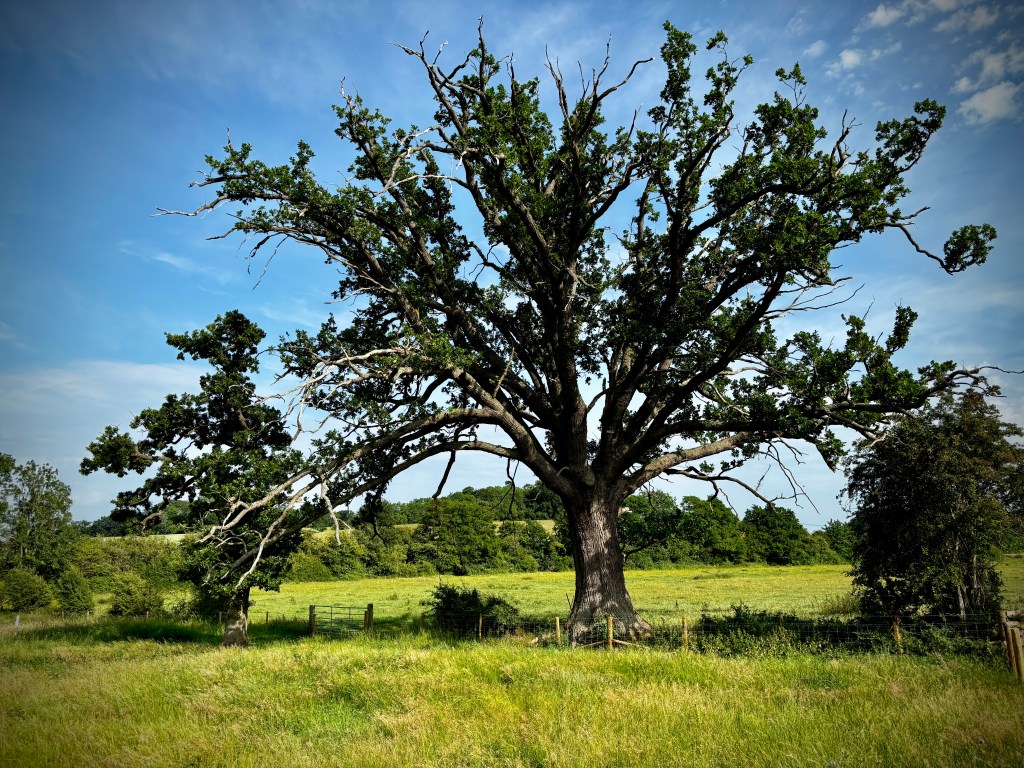
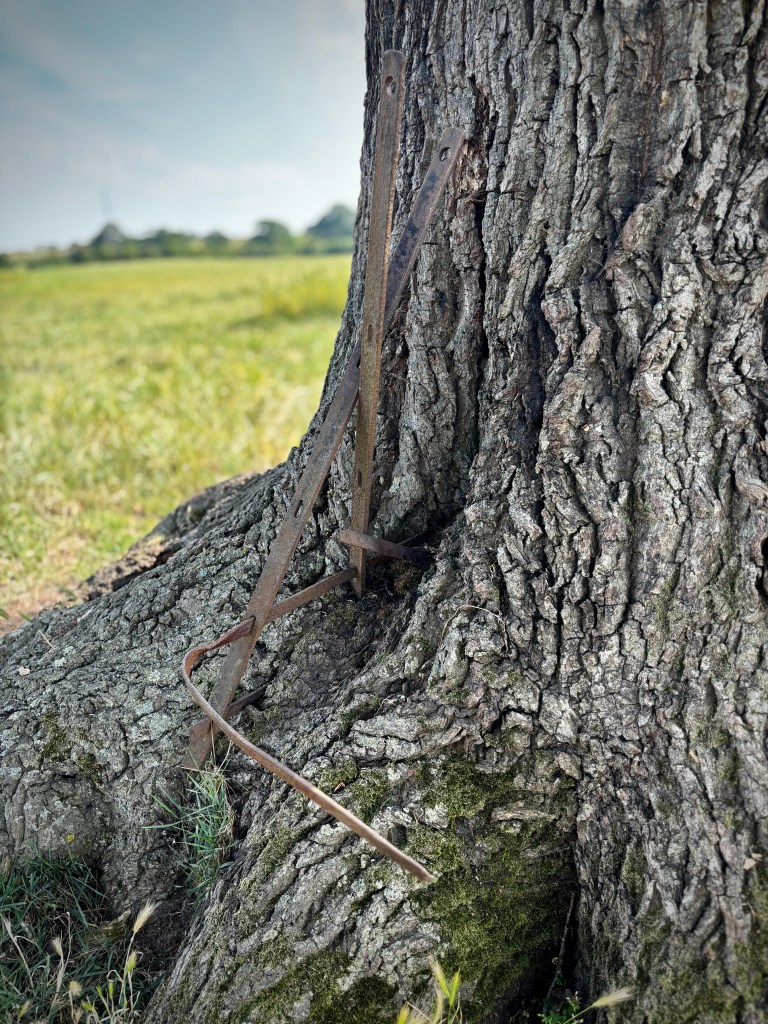
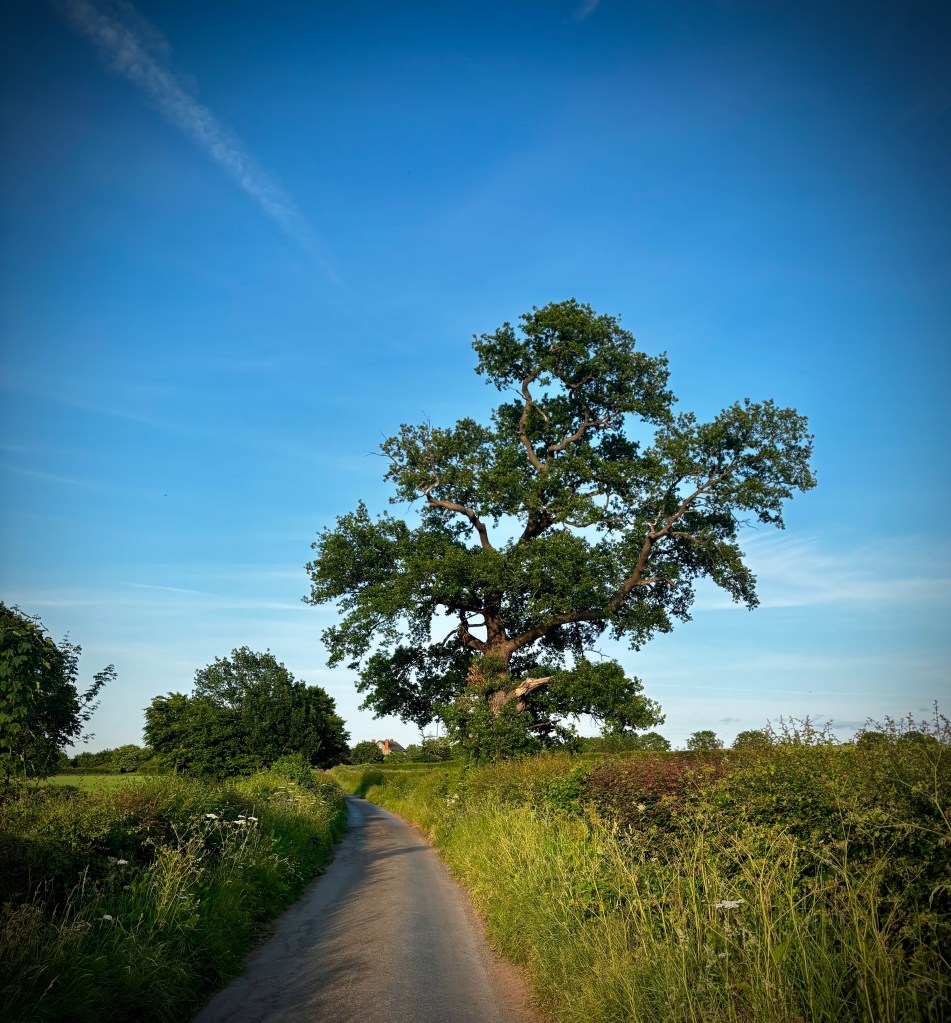
My favourite tree, possibly anywhere, is the great old oak that stands alone where once there was a hedge and estate fence. The hedge is now patchy at best and the only bit of the old Victorian wrought iron estate fencing that remains is that which the trunk of the oak has grown around and enveloped, taking it as its own.
According to a local ecologist, this tree is up to 500 years old. Like the land, it has been a constant in my life.
As a child, I attempted to scale its shear cliffs of bark. I swung from a rope swing suspended from it’s lower boughs. I camped beneath it on numerous occasions, and have done so recently whilst creating a wetland area. As a 10-year-old I had an old MOT failure, a French Simca 1000 (later replaced by a much better Triumph Dolomite), which I raced around the fields after harvest time, zooming through the gateway beneath this mighty oak, using it as a time marker. In my late teens, I engaged in romantic trysts beneath the shade of its vast canopy with girlfriends de jour, once being compromised whilst in such activity, completely “au naturel”, by a neighbouring farmer.
As the lower boughs succumb to the forces of nature and turn their direction of growth groundwards, the crown bears less vegetation than it used to. In springtime and summer, it resembles the head of an aged man with a thinning head of hair, almost perpetually in its autumnal season. Like all trees as they approach their final stages, this one is home to much life that is not tree.
Its hollow trunk is almost big enough to shelter inside, and there is evidence of it being home to various creatures of the wild. A bed has been crafted from dried vegetation and this room in a trunk has the aroma of animal, rather than tree – fox, pheasant, bat, hedgehog, rabbit, maybe all at different times. Looking up inside, decaying wood has formed like stalactites, pointed and cavernous, like looking up inside a cathedral tower.
Sitting beneath this majestic old oak, it is humbling to think of the centuries of history it has witnessed, and the changes that have taken place in the world whilst it has stood sentry in this part of Worcestershire. Assuming it is close to 500 years old, it would have been standing quietly here through the reign of Elizabeth I, the life of Shakespeare from neighbouring Warwickshire, the English Civil War, the collapse of China’s Ming Dynasty, the rise and fall of the British Empire, the Boston Tea Party and revolution that followed, the Industrial Revolution, the Napoleonic Wars, two world wars, the Cold War, Yuri Gagarin’s pioneering foray into space, then man’s further expansion to the moon and beyond.
So much has happened to the world and to us as a species, and this tree – like millions of others – has quietly endured. Rooted to its place on the planet, it has remained steadfast and silent, bearing witness to centuries of change. In an age of fast-everything, high-technology, and constant noise, maybe we need these silent, gentle giants more than ever. They purify the air we breathe, they provide food and shelter and support entire ecosystems, but, perhaps more importantly, they act as reminders of patience, resilience, and the quiet power of occasionally just simply standing still and observing.
Discover the Iron Age hill fort at Credenhill Park Wood in Herefordshire. A scenic, dog-friendly walk, rich in ancient history and natural beauty.
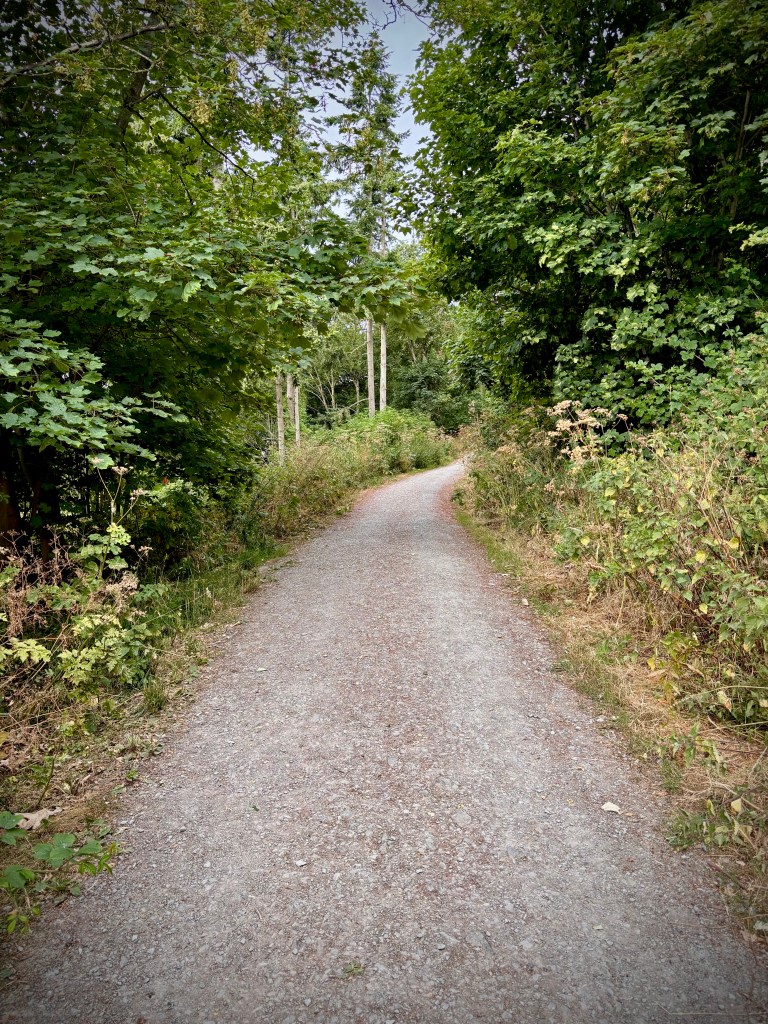
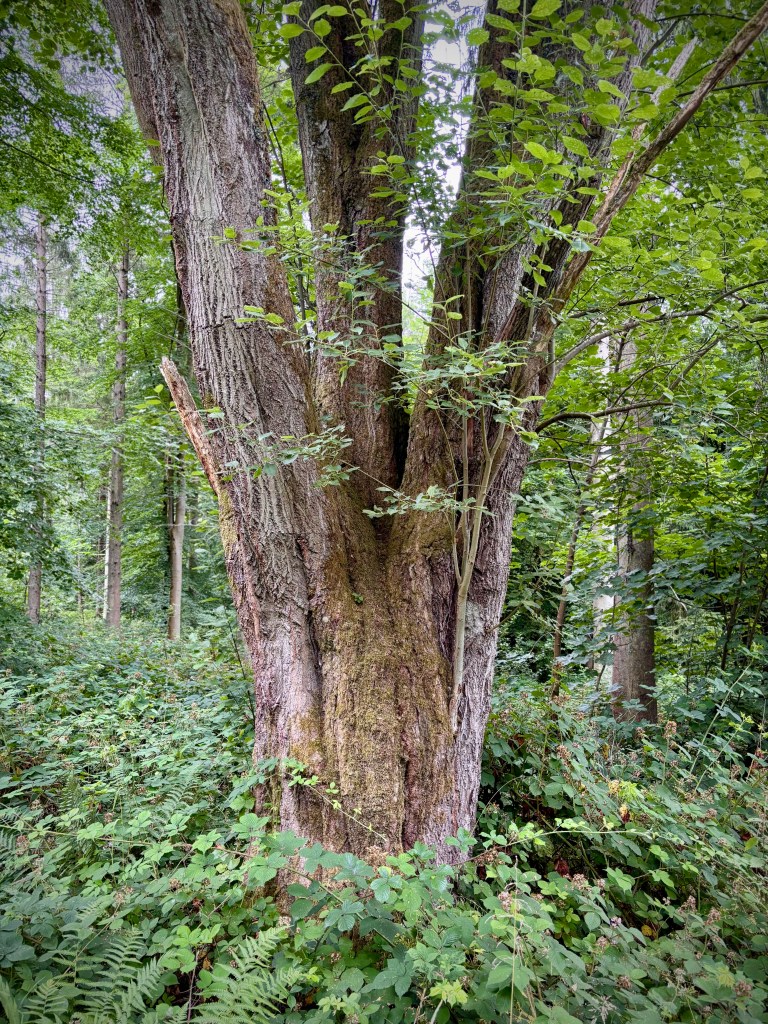
As I rise up the steep path – brambles and fern, elderberry and fireweed either side, tall trees beyond: oak, ash, fir and yew to name but a few – there’s a feeling of stepping back in time.
The Iron Age hill fort at Credenhill Park Wood is easy to miss. Just another hill bedecked in trees, nothing to see here, nothing remarkable. And yet thousands of years of history lies hidden, more secrets concealed than openly revealed.
The British Isles are quite literally littered with ancient hill forts – upwards of 4,000 and still counting. Whilst most were built during the Iron Age (800 BC to AD 43), there are many which stretch back in history to the Bronze Age (2,500 BC to 800 BC). Not far from where I live in Herefordshire is Credenhill Park Wood, home to the hill fort of the same name. Though Bronze Age pottery has been discovered at the site of the hill fort, it is assumed its heyday was about 300 BC, when it was populated by a British Iron Age tribe. These days, the site is owned and managed by the Woodland Trust, and is open with free access for all who care to make the trek upwards and into the past.
Early Sunday morning, the steep walk is silent but for the sound of my own feet crunching the gravel of the path, my dog rustling the undergrowth as she explores all manner of possibilities, and the chatter of chiffchaff and blackcap, echoing high above in the tree canopy.
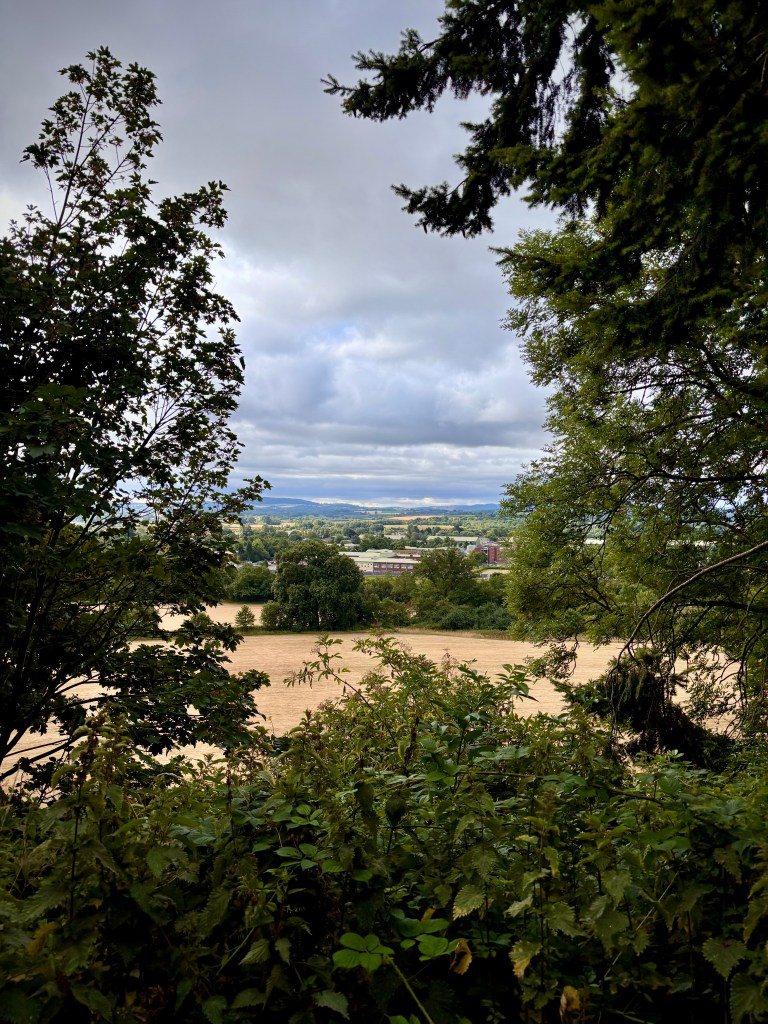
Glancing through various gaps in the trees, I see Stirling Lines – garrison of that famous regiment – the Black Mountains of Wales, Lord Hereford’s Knob and Hay Bluff are visible in the distance; a reminder of how close we are to Wales.
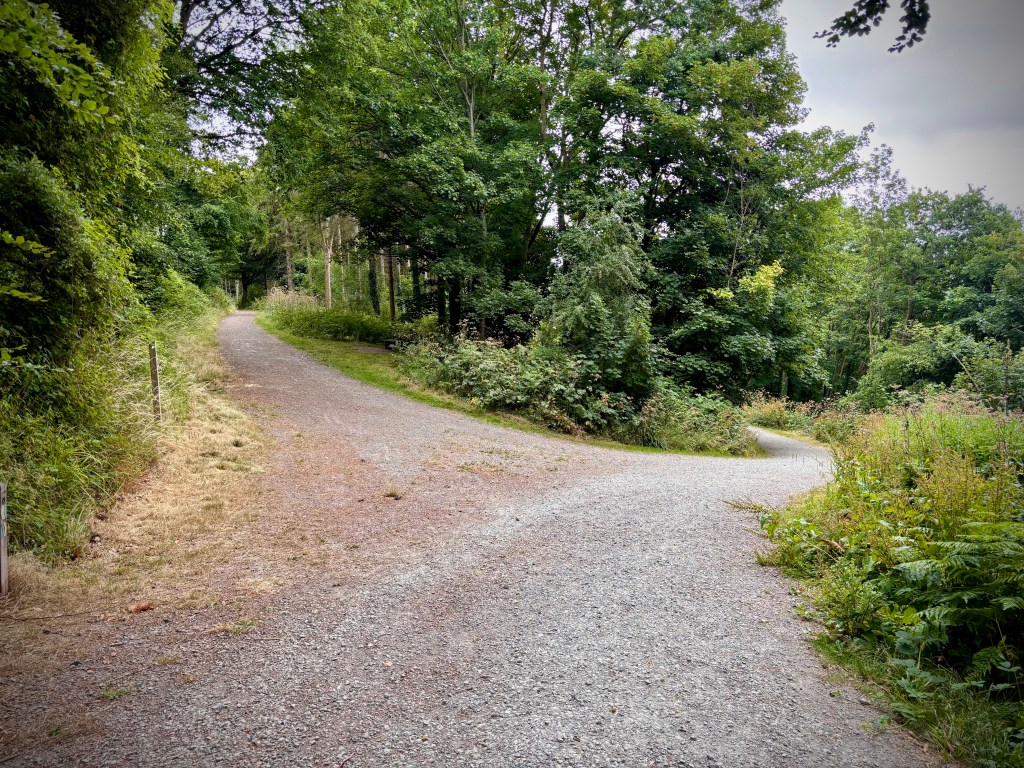
The path offers a choice of direction. I let the pooch decide and follow faithfully in her wake. We continue to rise and turn and rise again, the silence is both comforting and eerie all at once. Eventually, the path opens to the clearing on the top of the hill, bordered by high trees with Herefordshire visible on one side and Wales in the distance on the other. This open space, invisible from below, is the site of the ancient hill fort. I sit for a while, to enjoy the silence and solitude on this cool Sunday morning, and reflect on what this place is.
If you look beyond the open space and the trees and imagine the reason for its being, you can almost hear the ghosts of our ancestors. What was its real purpose? Defensive fort or meeting place, where goods and ideas were traded? The wide-held belief that all hill forts were purely defensive and military has been challenged of late. New archaeological thinking suggests these high forts might have been more commercial than military strongholds.
Though it’s nice to imagine this space as being a great commercial and social centre, its height, difficult access and physical advantage make one understand its appeal as a defensive position.
For thousands of years, people have sought refuge on this high ground and made use of the abundant resources and vantage its position has given it. Regardless of any other possible use, its value as a defensive structure is undeniable.
Following the Celts, the Romans are believed to have had soldiers here in the first century, and after them came the Anglo-Saxons. That age-old desire of the human race to fight and destroy provided an equally aged desire to defend oneself. Now, thousands of years later, whilst mankind is still less than kind, at least this particular piece of the world is now reserved for nature and the more peaceful past-time of exercise and relaxation, usually alongside man’s best and most trusted friend, the pooch.
My own family history is largely across the border from central Wales, as far as the coast, and all along this part of the Welsh Marches and its fluid boundary. Maybe my own ancient ancestors trod these same grounds thousands of years ago? Who knows how much of my DNA lies resting beneath my feet as I stride along the length of the site of the old Iron Age hill fort at Credenhill?
The sky looks angry and in the distance I can see rain clouds, like a veil of moisture obscuring the rest of the county from view. This is confirmed later by a fellow dog walker on my descent, who said he had planned a walk further up the county, only to find it under a heavy shower. Time is moving on and people are becoming more numerous. Joggers and walkers, most with dogs, the quiet solitude is broken.
When I first decided to devote a bit of land to nature regeneration, I began by planting trees. I earmarked 12 acres in total, with 10.5 acres for trees and the remaining 1.5 acres for, well, something else. I imagined birdsong, shade, and slow-growing permanence. It was the start of something hopeful: a personal attempt at almost rewilding a small Worcestershire landscape, in my own quiet way.
Now, a few months in, the woodland is taking shape. Thousands of native trees planted – English oak, birch, alder, hazel, rowan, lime, hawthorn, crab apple to name a few – though they’re currently struggling with the weather, having just had the driest spring for over a century and summer looking like more of the same.
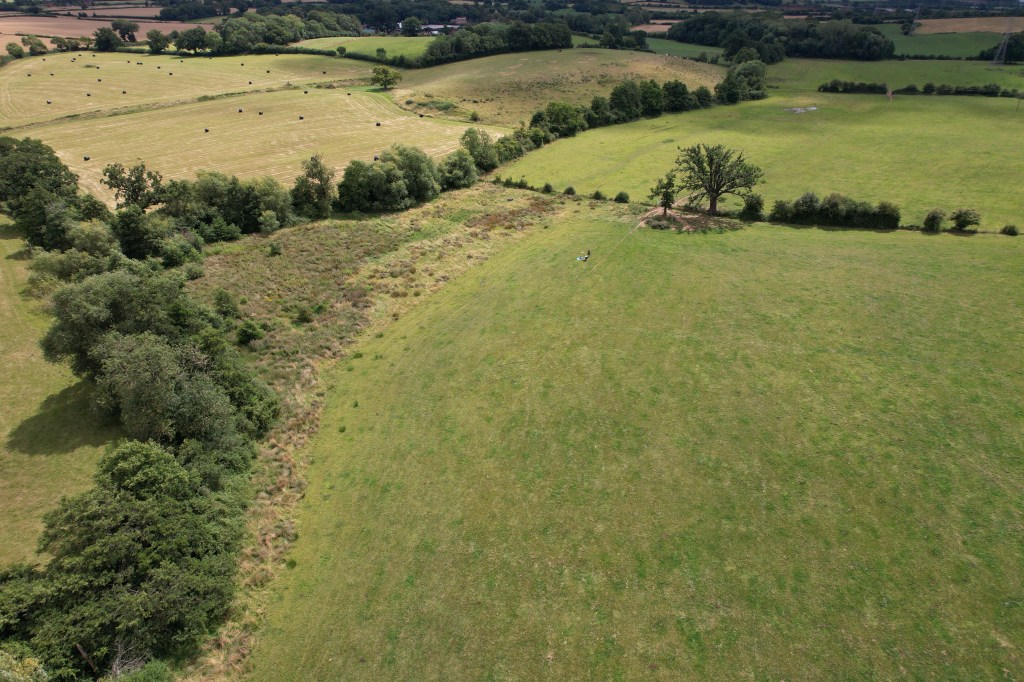
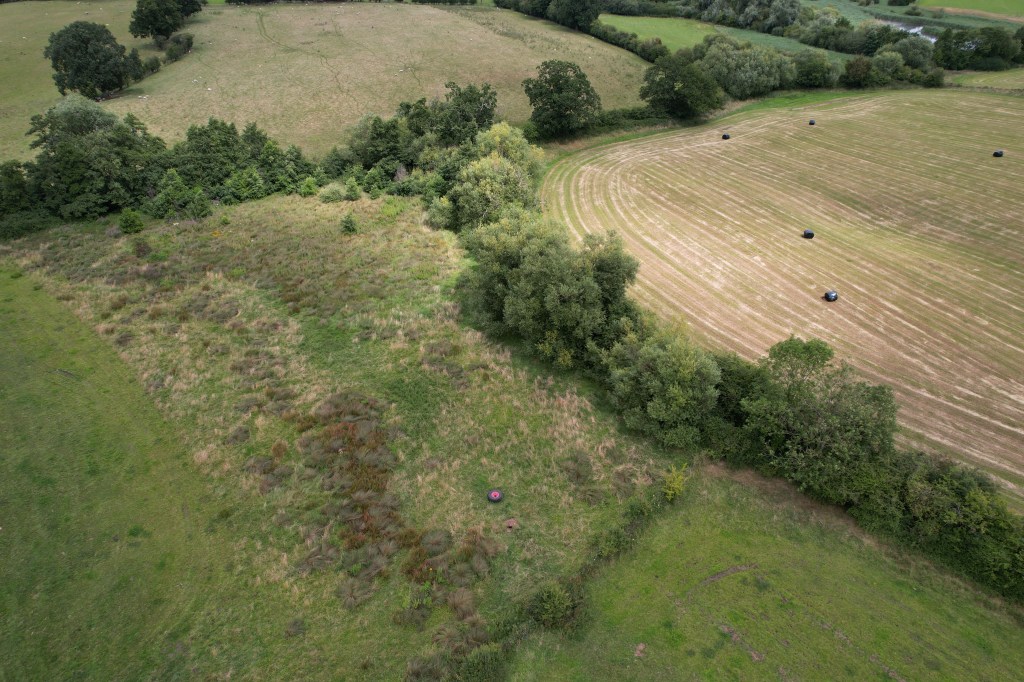
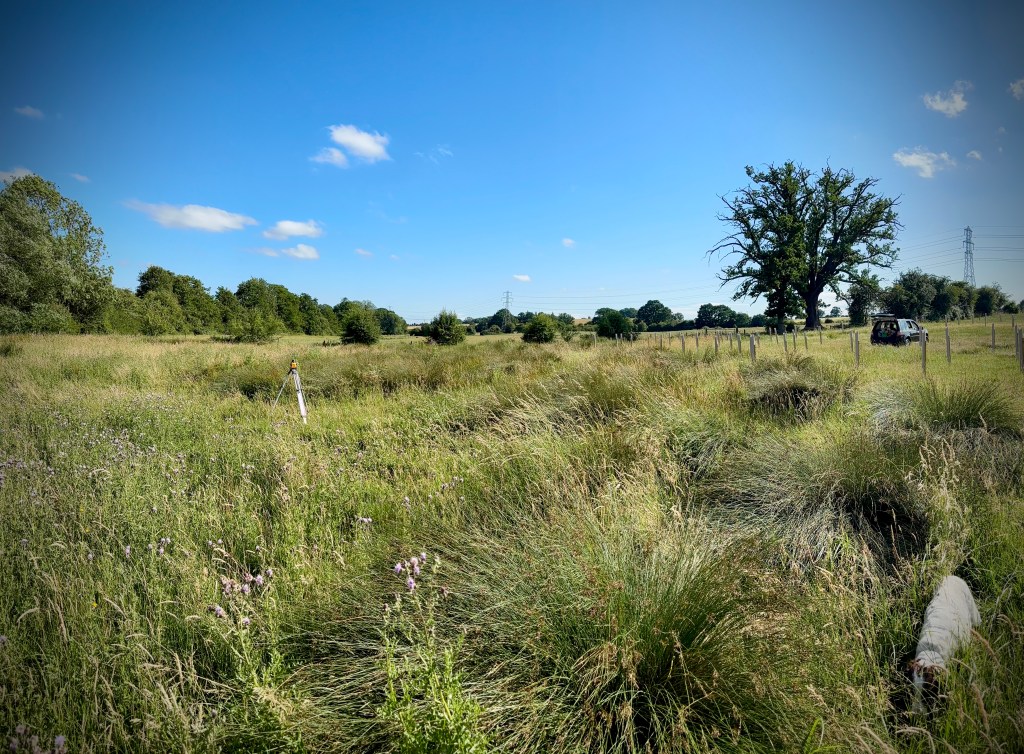
Next, the remaining 1.5 acres of the project. An area of low ground between the newly planted woodland and the brook. Traditionally damp and seasonally boggy, and with a piped spring and land drain beneath the ground, this seems the perfect location to create a new wetland habitat. I envision water, marsh, and a light-touch sculpting of this land, with nature taking over, and all beneath the gaze of my favourite old oak tree.
Proposed wetland area from drone, westProposed wetland creation area, from different angle
Why Create a Wetland next to a Woodland?
Planting thousands of trees and creating a new woodland alone can support incredible biodiversity, but the real magic happens where ecosystems meet. Wetlands and woodlands coming together create a transition zone where different habitats overlap. These can often be the richest areas for wildlife.
Key reasons for creating the wetland:
Biodiversity: A wetland should attract amphibians, dragonflies, wading birds, other mammals, and plant species that wouldn’t thrive in the woodland alone.
Water management: It slows runoff, absorbs rainfall, and helps prevent flooding further downstream.
Climate resilience: Acts as a carbon store, and can create a microclimate buffer during very dry periods.
Personal reward: Watching frogs and other amphibians populate the pool areas, birds and wading birds, bees and nature take back control. Adders might be a stretch too far in this part of Worcestershire, but grass snakes are possible and there have been sightings of Aesculapian snakes in nearby Oddingley. Ironically, the one creature in the world that I don’t like and that gives me the raging heebie-jeebies like no other, is the snake. Any snake. All snakes. Still, live and let live, I guess.
Surveying the proposed wetland area and taking levels
How I’m Hoping to Create it: Designing the Wetland
The site is naturally low-lying, with slow-draining marl below the topsoil – ideal for holding seasonal water. The land is littered with Bunter cobbles/pebbles, deposited during the Triassic period more than 200 million years ago.
My first thought was to create a deep, lake-like feature. Instead, I’m looking to:
Create three small pools of varying depth, the largest with an island sanctuary for birds
Create shallow scrapes and margins for muddy edges and seasonal wet grassland
Create gentle slopes to allow wildlife access
Create a permanent wet core, through deep areas, supported by springs even during dry years
The hills either side are like huge storage areas of water, consisting of glacial stone deposits. Or so I am told. There’s a piped spring under this area and above it a land drain. The latter rarely runs, possibly long since crushed by heavy modern machinery, but the spring has never run dry in living memory, even during the record-breaking dry summer of 2022, when temperatures in excess of 40c were recorded in the UK.
Progress to Date:
Sought expert advice from ecologists and wildlife experts. I’ve had some input and a few conversations – always open to other opinions and advice.
Surveyed the land to identify the true contours and taken levels, to establish a more accurate picture of the area’s topography.
Dug a trial pit in one of the other low-lying areas further up the brook to test soil moisture during this dry period and validate my assumptions.
The brook, much reduced by the current dry spellHedgerow and trees along the brook edge
Woodland and Wetland Together: A Connected Habitat
My woodland is still young, but as the trees mature, I’m hoping their root systems and canopy will interact with the wetland edge, and together they will become part of the larger connected landscape.
On the other side of the woodland is a newly erected stock fence. I’m hoping to plant a new hedgerow along its length, creating a natural corridor between two existing hedgerows about half a kilometre apart and bordering the new woodland. The hedges at either end connect to the hedgerow and tree system that has bordered the brook for centuries.
I’m interested to see how various species will use these new habitats: birds nesting in trees but feeding on aquatic insects, amphibians using the cover of shrubs to move between water and woodland, and bees pollinating what will be a largely undisturbed and organic environment.
This isn’t a sealed-off project; it’s a connected system. One that, over time, should support a broader range of life than either habitat alone.
What’s Next? Suggestions?
I’ll keep documenting the project as it evolves. Over the coming months, I’ll post updates on:
Its development and natural evolution
Species sightings
Water levels, and the seasonal changes in the area.
Once it starts to take shape I’m thinking of beehives, a program of wildflower planting to help move things along, low level camping or accommodation for nature watching, trying to encourage the pheasants that often come to the land to escape the guns of the local shoot (a controversial one given their non-native status), and, once the trees have really established themselves, maybe welcome the roe deer which naturally roam the land – but are currently unwelcome due to the saplings.
In the meantime, I’m open to suggestions and advice, if anyone has knowledge or experience of creating something similar. I believe this kind of project thrives on shared knowledge and experience. Please contact me or comment below. I’d love to hear from others on a similar journey.
From Foggy Albion, where the frogs are back and the trees are growing, thanks for reading.
I was lucky enough to grow up in the seventies and eighties, a time when music was better, cars were more interesting and proper, good, wholesome bread could still be found on most high streets in independent bakeries. The full-scale decline hadn’t yet set in. Bakeries were already on the breadline, but the rise of large out-of-town supermarkets in the seventies, the dominance they really started to hold over towns and cities in the eighties, and the cut-throat loss-leaders and price wars of the following decades had yet to have their truly crippling effect.
Most areas still had local bakeries where a decent loaf could be purchased at a reasonable price. The soft, mushy, chemical-laced imitation, shrouded in plastic, was more readily available on supermarket shelves. And although bakeries also did standard white sliced, they offered more traditional options too – and, arguably, better quality.
[Pics and video below]
Granary Memories and Banana Butties
Growing up in the countryside, we had a local bakery not too far from the farm, and bread was delivered daily throughout the area by the baker himself, along with the daily newspaper. Freshly cooked and still warm, granary bread would arrive in a retro vintage baker’s van – an interesting gimmick that was a nice touch, but failed to increase sales in any significant quantity.
That granary was delicious as toast, bathed in butter, but for some reason this particular loaf was best used for banana butties. A couple of thick slices, bountiful quantities of butter, and then a banana crushed roughly between the two slices. It worked a treat and totally hit the spot. Whilst man, or woman, cannot live on bread alone, it certainly can be a valuable and welcome addition to anyone’s daily diet.
Bread: A 14,000-Year-Old Staple
Apparently, bread has its roots in a time long before the last ice age – more than 14,000 years in the making. Back then, our ancestors likely broke bread with one another using unleavened flatbreads. Since those earliest loaves, it’s evolved into a staple food across countries and cultures.
From the Aerated Bread Company’s innovations in the late 1800s to the nadir of the Chorleywood bread process in the sixties, British bread-making lost its way. It hit a low point, in my opinion, in the late 20th and early 21st century, when supermarkets started offering white-sliced loaves for as little as 10 pence. At first, I was impressed – it felt like a food price revolution. I confess, I took advantage of what appeared to be a bargain.
But as with all things that seem too good to be true – it was.
When Bread Got Too Cheap
There’s no such thing as a free lunch. Selling food at that price means someone, or something, is paying the price somewhere else. These bargain loaves, moreish and irresistible loss-leaders, contributed to driving small bakers out of business – brown bread, quite literally. Meanwhile, the nation’s health suffered. Many of these cheap loaves were, allegedly, nutritional deserts. Heavily refined white flour, sugar and salt appeared to be the main ingredients, along with, often, a plethora of even less desirable additives.
Things were even worse in the Far East. Living in Thailand in the nineties, I witnessed such crimes against baking and good taste as chocolate bread, with the crusts pre-removed, wrapped in glossy plastic and bearing only a distant resemblance to what most think of as bread.
My Homemade Bread Awakening
My personal bread revolution began not long after. I started cutting down on bread and choosing better quality when I did buy it. “Lower quantity, better quality” became my mantra – my daily bread, if you will. The greatest thing since sliced bread, for me, was a return to a more traditional loaf.
So, digging out my trusty Kenwood A701A, I set out to learn the ancient art of bread making. Quick side note; I must pay homage to this legend of the kitchen. This Kenwood is actually older than me, bought by my parents in the late sixties – the decade prior to my arrival on planet earth. I acquired it as the spoils of their divorce in the nineties. It’s still going strong – fingers crossed here – and has never had any issues. The grinding attachment was lost and the liquidising/blending attachment got dropped and cracked, both parts easily replaceable, should I wish to pony up the requisite rhino. It was made in England, at a time when things were still built to last – it has been used regularly every decade since purchase and never missed a step.
I tried mixing and kneading and various different methods and bread mixes, and followed all manner of online and recipe book suggestions; some simply beyond my somewhat limited abilities and others rather half-baked. My first few loaves came out more weapon than sustenance – dense enough to use as doorstops, and could injure someone at 20 paces, if thrown.
Kenwood A701AMixed wholemeal and rye loaf
Perseverance and patience are the watchwords.
Finally, I settled, or perhaps stumbled, upon my own creation, a sort of fusion of various recipes and techniques. Starting it in the mixer, it then gets transferred to the board for some old-fashioned hand kneading, on oil rather than more flour. I generally use a mix of flours, usually wholemeal, accompanied by either rye, khorasan or spelt. I’ve never actually managed to faithfully reproduce the granary bread of my youth, but I’ve found that toasting a mix of seeds (usually pumpkin, flax, sesame and sunflower) and adding them at the kneading stage produces quite a nice bread. It’s taken years of trial and error, but I’ve finally arrived at a loaf I’m genuinely proud to eat, and even serve up to guests.
Ditching Shop-Bought Pizza and Focaccia
Ready-made pizzas are a thing of the past too. A simple recipe for pizza dough and a little patience can deliver delicious results. In my opinion, far superior to any of the shop-bought offerings and free from additives and other nasty unknowns. Once you’ve had a good homemade pizza, the cardboardy offerings of many outlets and frozen options feel like a disappointment you can do without.
Staying with Italian delicacies, I’ve also discovered how to knock out a halfway presentable focaccia. I try not to do this too often – not because of the effort involved, but because my self-control goes out the window. One piece leads to another and then more, and let’s just say there’s only so much olive oil and salt one should consume in a single sitting.
Focaccia ready for the ovenFocaccia ready to eat
Breaking Bread Without Breaking the Bank
Another win for homemade bread? It’s affordable. Even with organic flour, seeds, and oils (most of the time), I can make a loaf for just under a quid. Go for basic ingredients and it’s even cheaper. Same for pizza and focaccia – cheap as chips, and every bit as tasty.
The Perfect Banana Loaf Still Eludes Me…
I’m still searching for the perfect accompaniment to a banana, like the granary bread of my youth. But what I’ve created is good enough – at least for me. I’m no Bake Off contender, but I’ll keep punching dough, breathing in the scent of fresh bread filling the kitchen, and diving into the first buttery crust while it’s still warm (vegan butter these days).
I’m still searching for the perfect accompaniment to a banana, like the granary bread of my youth. But what I’ve created is good enough – at least for me and for now. I’m certainly no Bake Off contender, but I’ll keep punching the dough and enjoying the delicious smell of freshly baked bread that fills the kitchen every time, and diving into the first buttery crust while it’s still warm (vegan butter these days).
From folklore to foraging – the hidden wonders of Britain’s living boundaries.
Often overlooked and sometimes taken for granted, Britain’s hedgerows are among the oldest features of our rural landscape – living relics that have bordered our fields since Neolithic times. They likely began as remnants – trees and shrubs left standing after Neolithic farmers cleared land for crops, forming natural and protective boundaries between neighbouring plots.
Evolving into dense thickets of vegetation of all manner of varieties, offering protection from wind and roaming stock, as well as property demarcation, hedges provided a whole ecosystem of life and valuable source of material and resources such as whips and berries, herbs, fruit and medication.
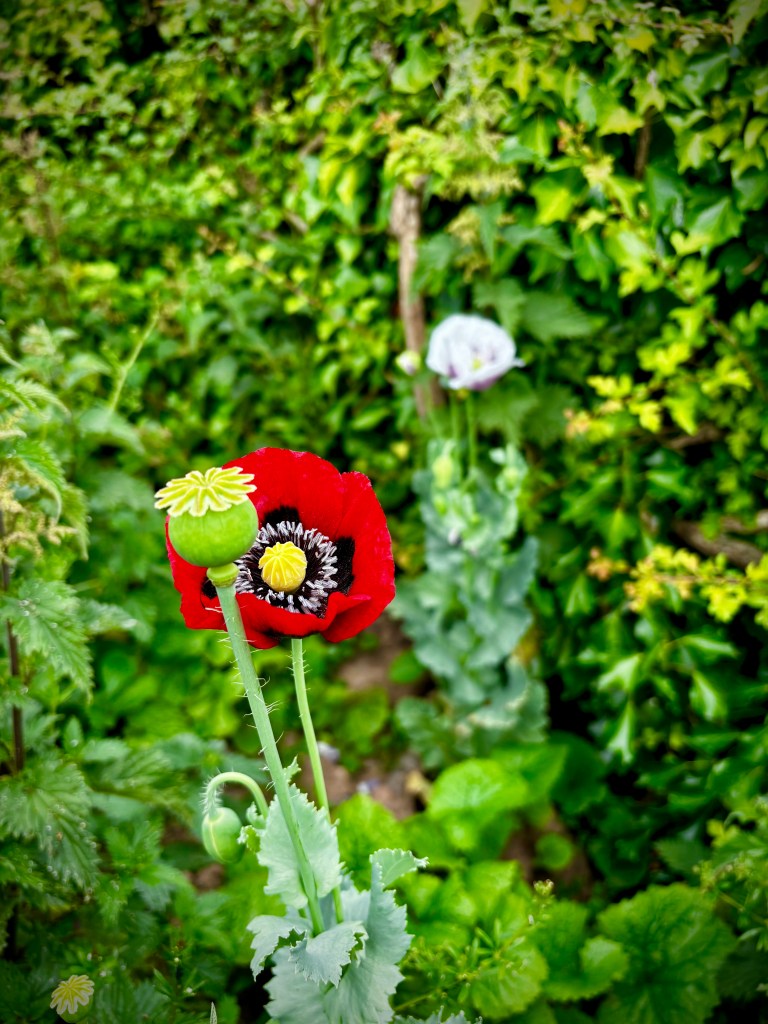
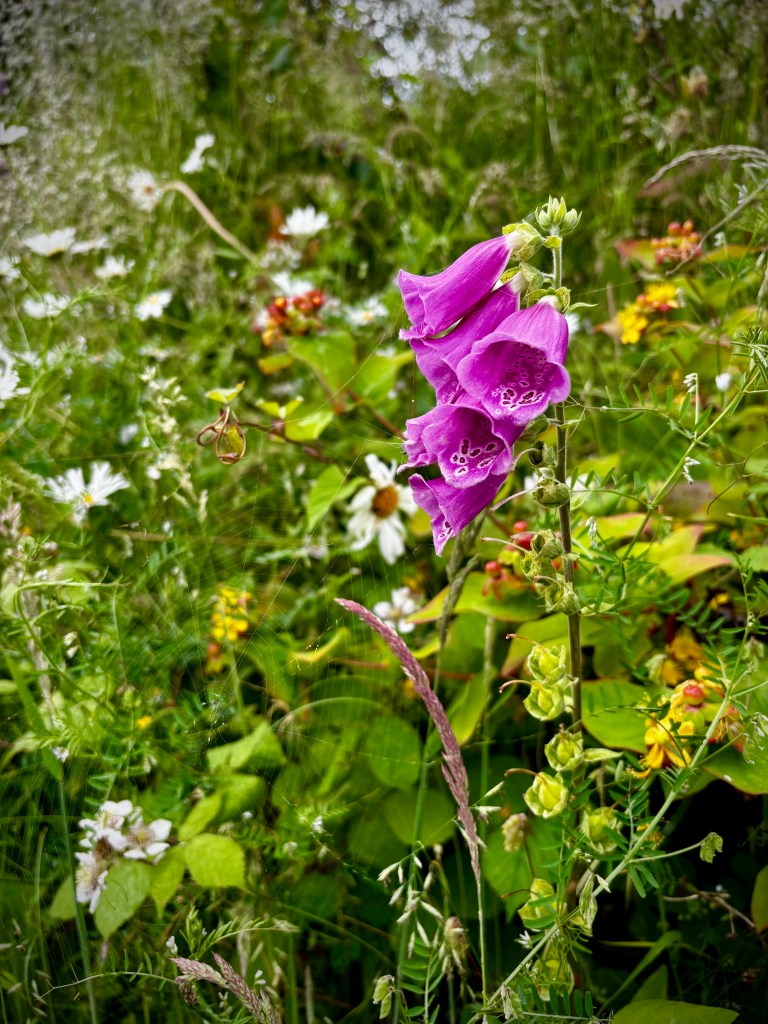
Poppies – now associated with Remembrance Day, less common in the wild in the UK, as a result of intensive farming.Foxglove/ladyfinger. Historically had medicinal uses, but these days more usually a staple of the traditional English garden.
Currently, this island, this “foggy Albion”, is a lattice-like network of hedgerows, creating a patchwork of fields of many colours. One can only imagine how it must have looked before the great hedge removal introduced by Clement Attlee’s government in 1947. This countrywide destruction continued until controls were introduced by John Major’s government in 1997. Hedges are now being, increasingly, appreciated for their ecological and environmental importance.
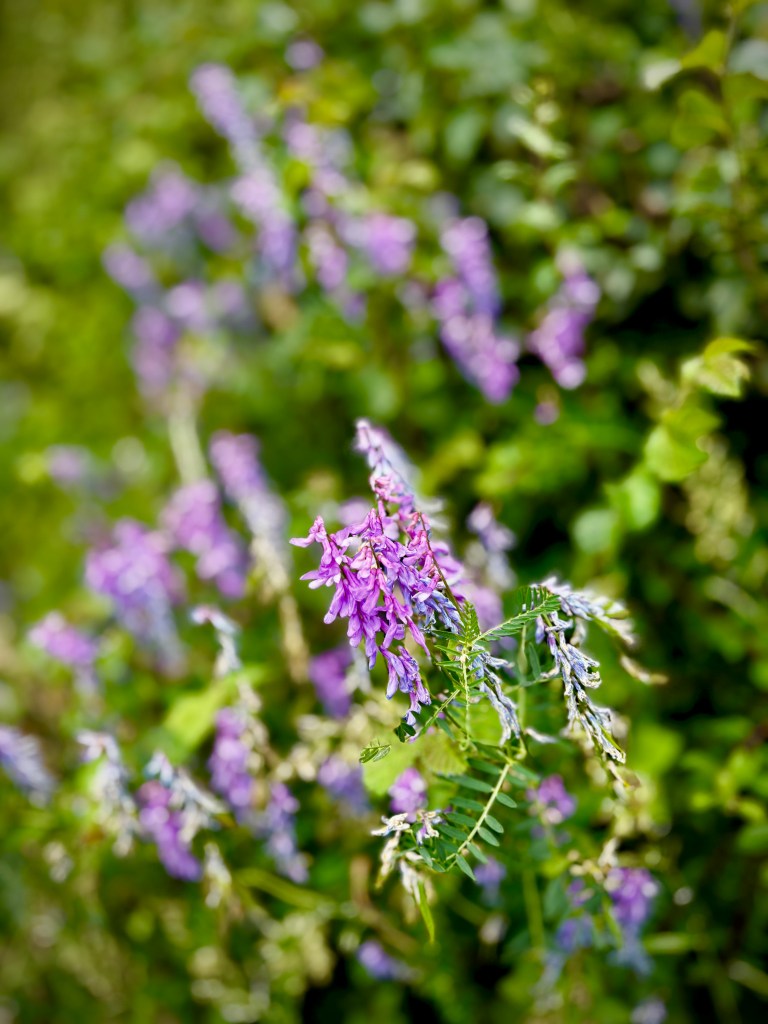
Bird vetch – nitrogen fixer, good as green manure. Good for pollinators.Nipplewort – traditionally used as both medicine and food.
Hedgerows are not just animal and vegetable – they’ve also contributed to the mythical fabric of British history. In British folklore, hedges are a gateway from good to bad, safe to wild, and a boundary separating the civilised from the uncivilised. Nature’s motorway or highways for hags – the word hag is believed to have derived from the old English for hedge, and hags, or witches, were reputed to have been able to traverse between the civilised and uncivilised worlds through hedges. Fairies were also said to frequent hedgerows and use them as a link between worlds. The May Tree, more commonly known these days as the hawthorn, traditionally played a big part in May Day celebrations, going back to pagan times. Maypoles used to be decorated with the branches and flowers of hawthorn, which were also used to make the May Queen’s crown, Fairy Queen’s crown and the Green Man’s wreath.
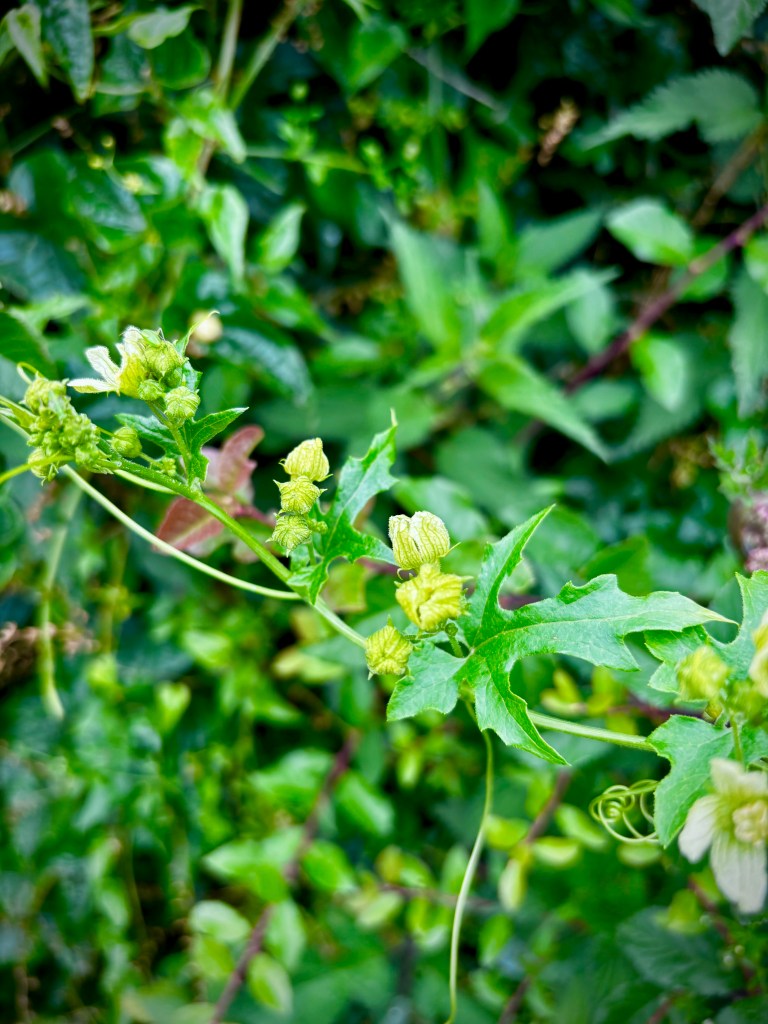
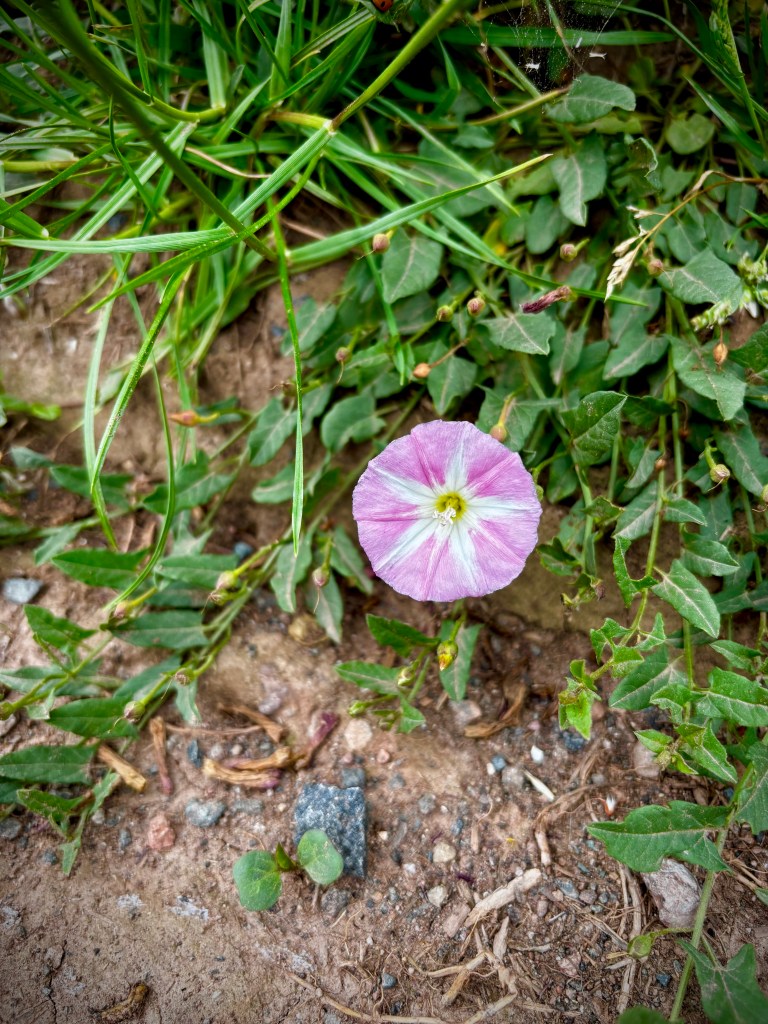
Red bryony – previously used for medication.Field bindweed – traditionally used as a laxative.
Land’s End to John o’ Groats is perhaps the greatest hiking challenge in the UK, at a shade under 1,000 miles. Nothing by comparison to the length of our hedgerows though, which stretch for an estimated 700,000 km (approx 435,000 miles). That’s about 17 times around the earth at the equator, or to the moon and almost back again. Most are in England, with the biggest concentration in the south-west, especially Cornwall. Shockingly, it’s estimated we’ve lost up to 50% of our hedgerows since the late unpleasantness of WW2 and the desperation for improved food production that followed.
As a child, I learnt to appreciate hedgerows and had a fascination for these life-filled, almost parallel worlds, snaking through our own. Day or night there’s always something going on. If “there’s a bustle in your hedgerow,” it might well be a “spring-clean for the May queen”*, or could be one of the dozens of creatures that still use hedgerows for safe transit and for foraging and hunting. Night walks are best to hear the rummaging from within. In the evening, the buzz and hum of insects and birdsong is replaced by the rummage of rodents, and rustling and shuffling of badgers and deer, or the startled scampering of rabbits as you approach them.
Elderflower – used in cooking and cordialElderberries – after the blossom comes the berries. Good for cordial, jam and elderberry wine.
Growing up in the seventies and eighties, foragers and their wicker baskets were a regular sight during the summer, gathering blackberries from the hedgerows – completely free. I can’t remember the last time I saw anyone doing this. The berries never left, but these days most people forage in the aisles of supermarkets, where these same blackberries can be purchased in neat plastic boxes, often flown in from beyond these shores. It’s the same with elder, crab apples, sloes, and hazelnuts; all still in abundance in our hedgerows. I still take blackberries and crab apples from the hedges on my little piece of land – easily transformed into a delicious blackberry and apple pie. I’ve yet to beat the local squirrel fraternity to the hazelnuts though – those guys really do know a thing or two about nut foraging.
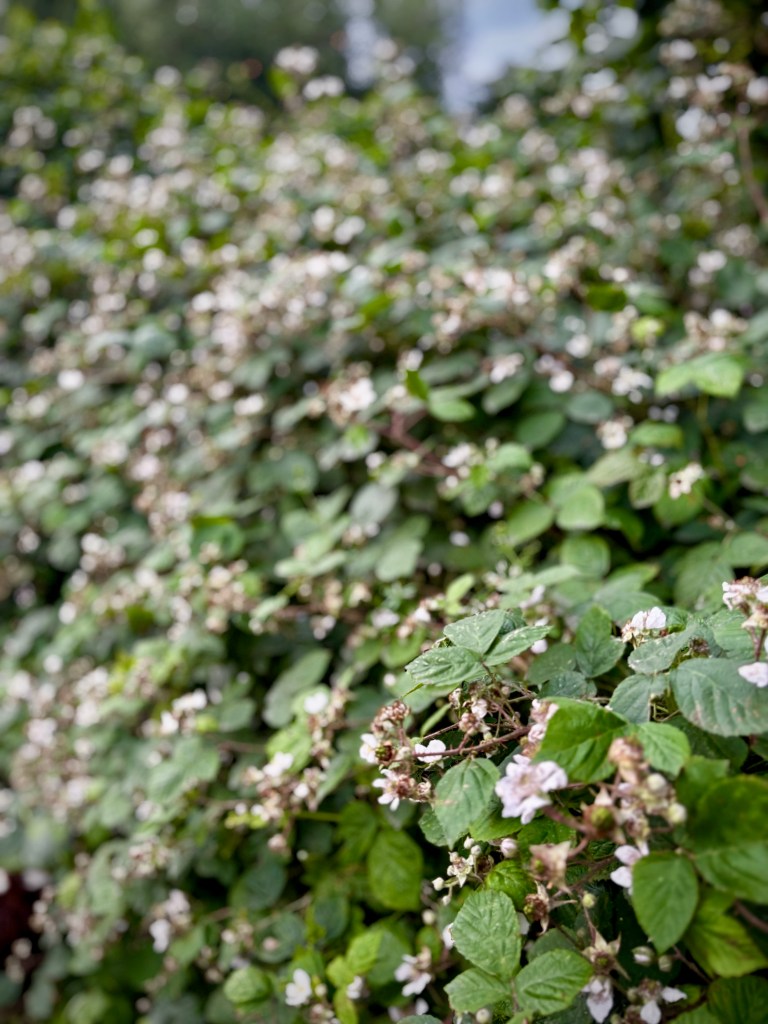
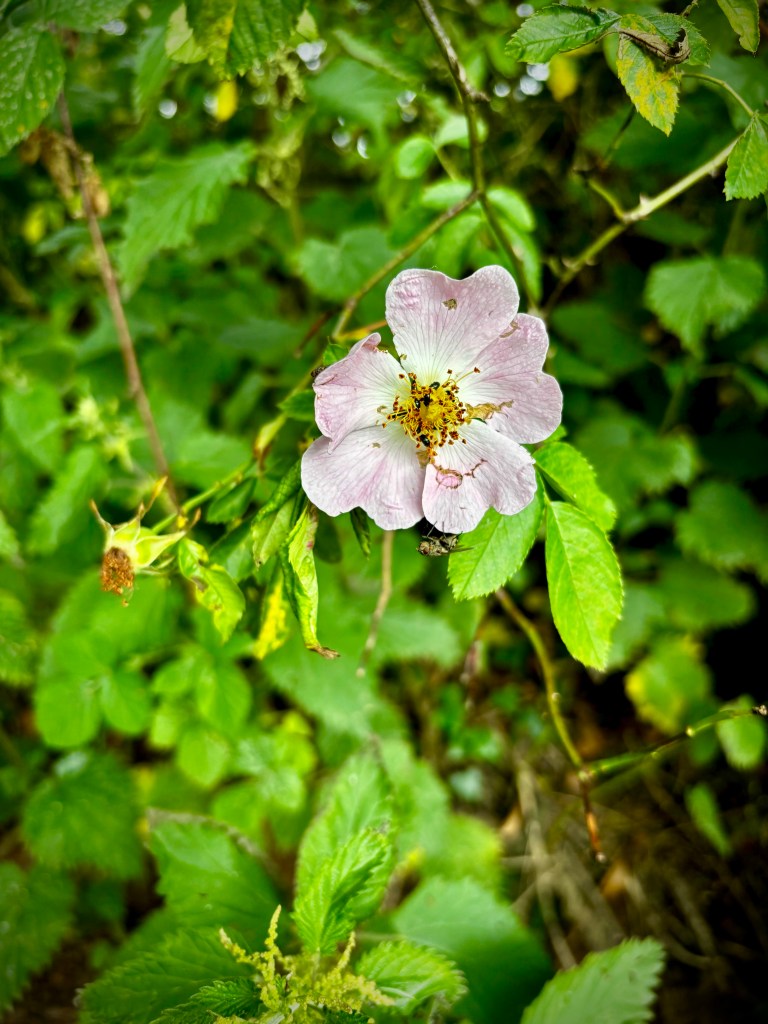
Brambles. Later in the summer the flowers will become blackberries.Dog rose
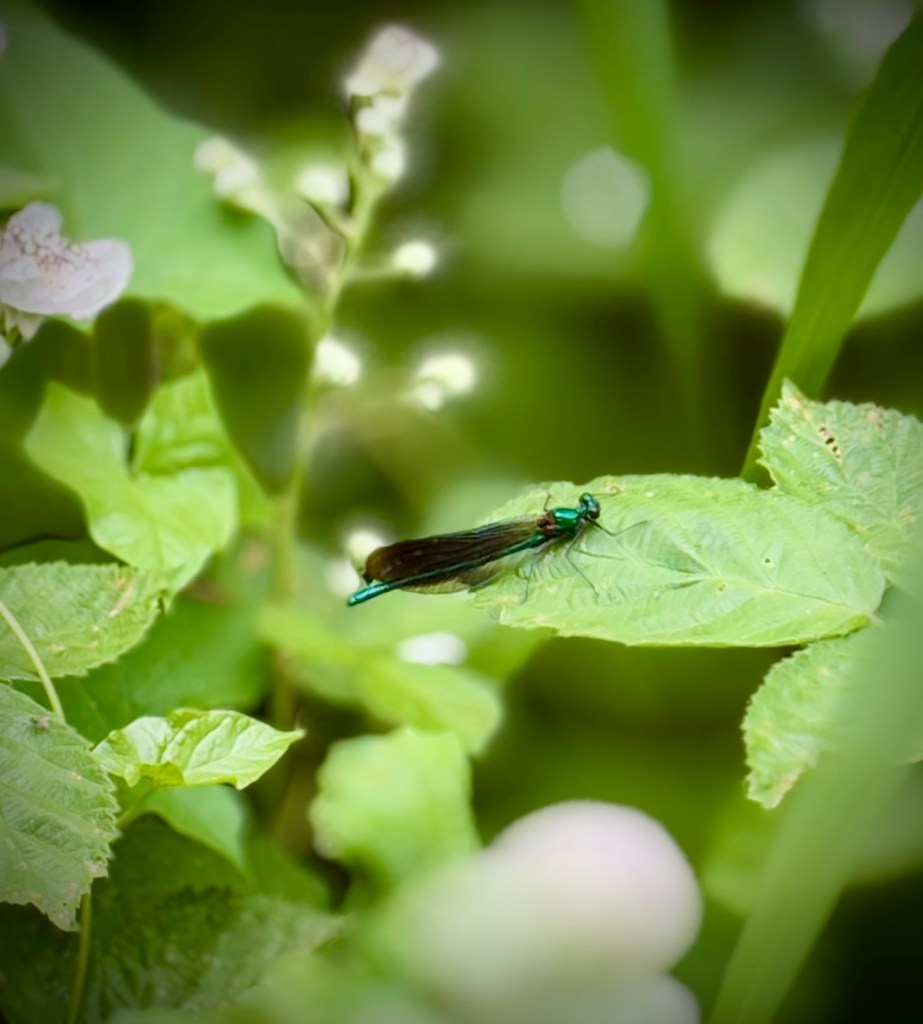
Walk along any hedgerow on a nice day, and you’re sure to hear the buzz and hum of bees and other pollinators, the graceful comings and goings of butterflies, and, depending on location, damselflies and dragonflies. Birds nest within the thicker, more dense parts of the hedgerows, which provide greater protection, and their delightful chirruping and singing provide a pleasant accompaniment to the other sections of nature’s orchestra – Blackbirds, Robins, and Chaffinches to name just a few of the birds you’re likely to find playing taking up residence among the hedgerow ecosystem.
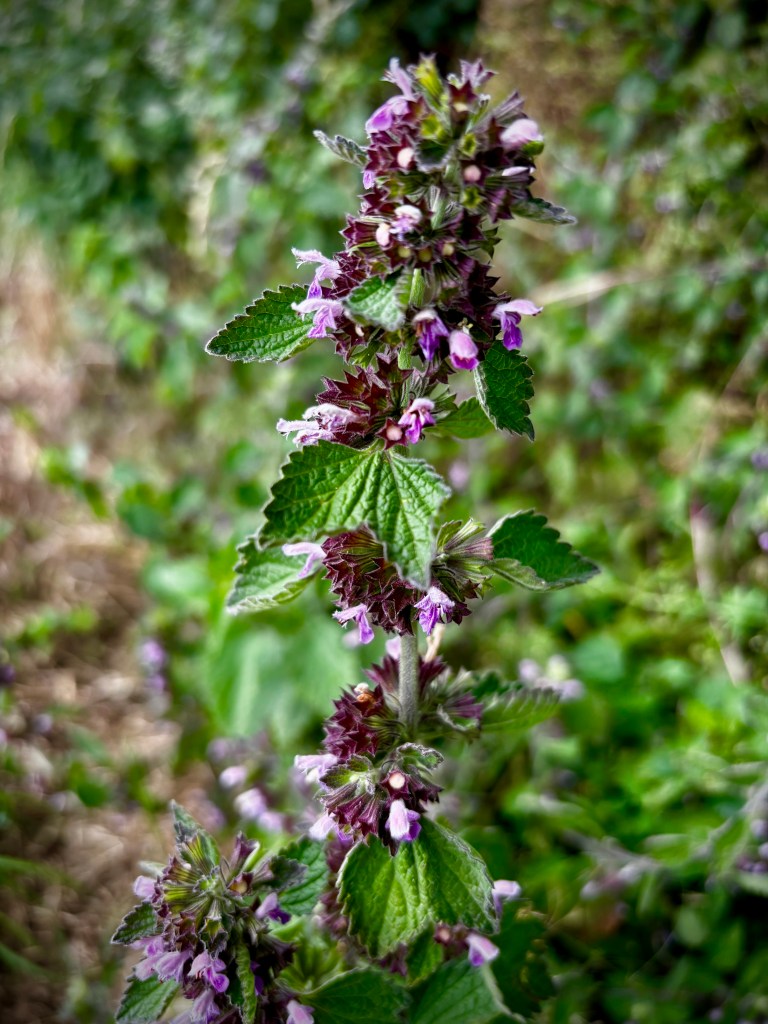
DamselflyBlack Horehound, AKA “Stinking Roger”. Traditionally used as a herbal medicine.
The hierarchy of hedge height often means you will find trees that have managed to grow high above the lower line of the hedge; oak, ash, and lime towering over those of more limited stature. Main hedge structure of hawthorn, blackthorn, hazel, holly or field maple is common, often a combination of all those, along with dog rose, elm, elder and ivy. Then the smaller, in terms of height, contributions from bramble, cow parsley, a plethora of grasses and various shrubs and wild flowers make up the rich visual tapestry of colours and textures.
The scent of hedgerows can be as diverse and enticing as the visual appearance. From the sweet, honey perfume-like scent of lime trees to the gentle delicate aroma of dog rose to the divisive offerings of hawthorn blossom and the more delicate fragrance of elderflower and blackberry blossom.
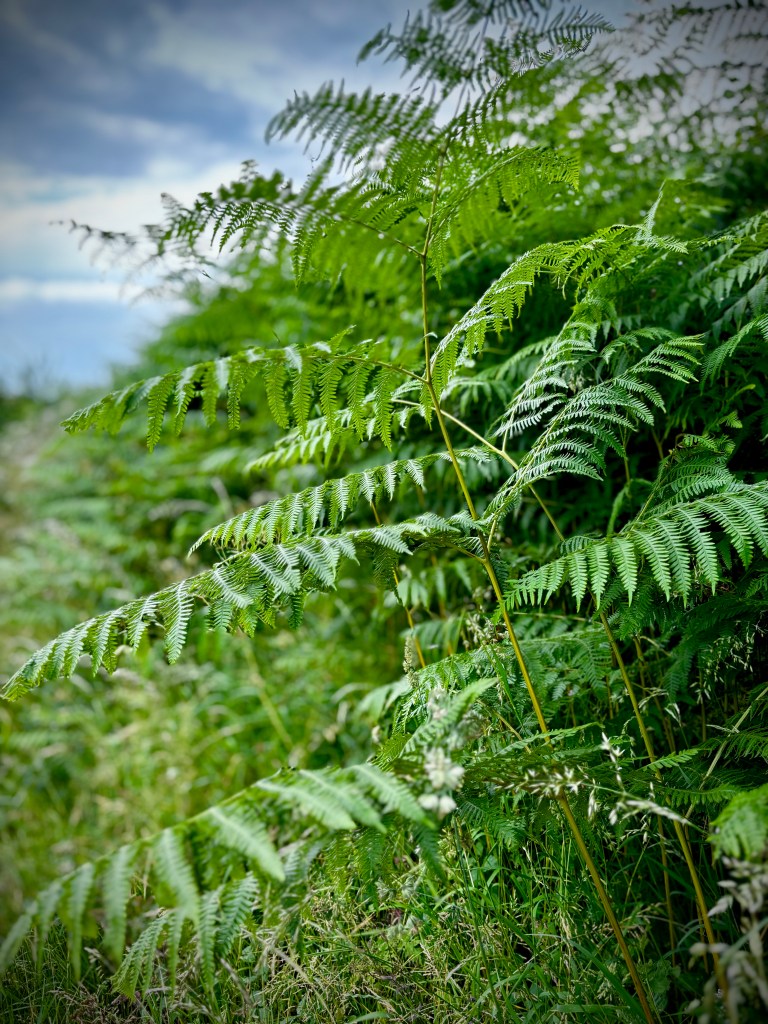
Bracken – fossils of this widespread plant have been found dating back more than 50 million years.Herb Robert – traditionally used as an antiseptic and cure for nosebleeds.
Walking the hedgerows daily with my dog, she noses through the undergrowth as if the world’s secrets are written in scent. And maybe they are. Ancient, magical, and utterly alive – hedgerows are so much more than just green boundaries. These living relics breathe history and biodiversity into every mile they cover. In a world that moves fast and forgets easily, perhaps they’re a reminder for us to slow down. To look. To reflect and remember.
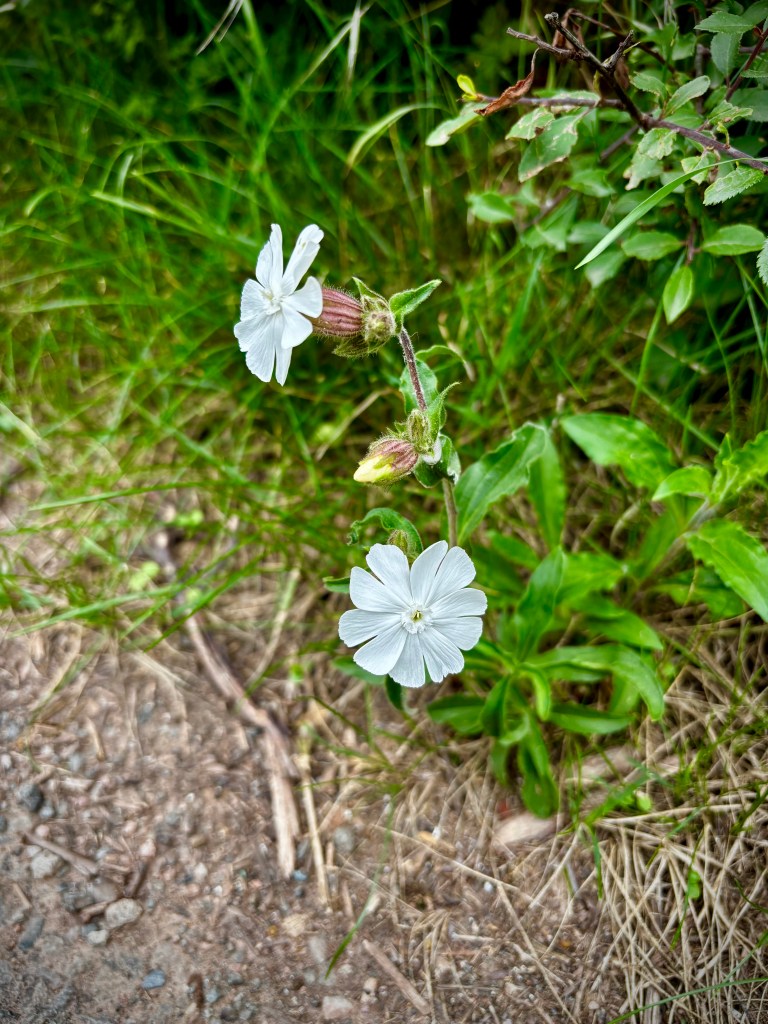
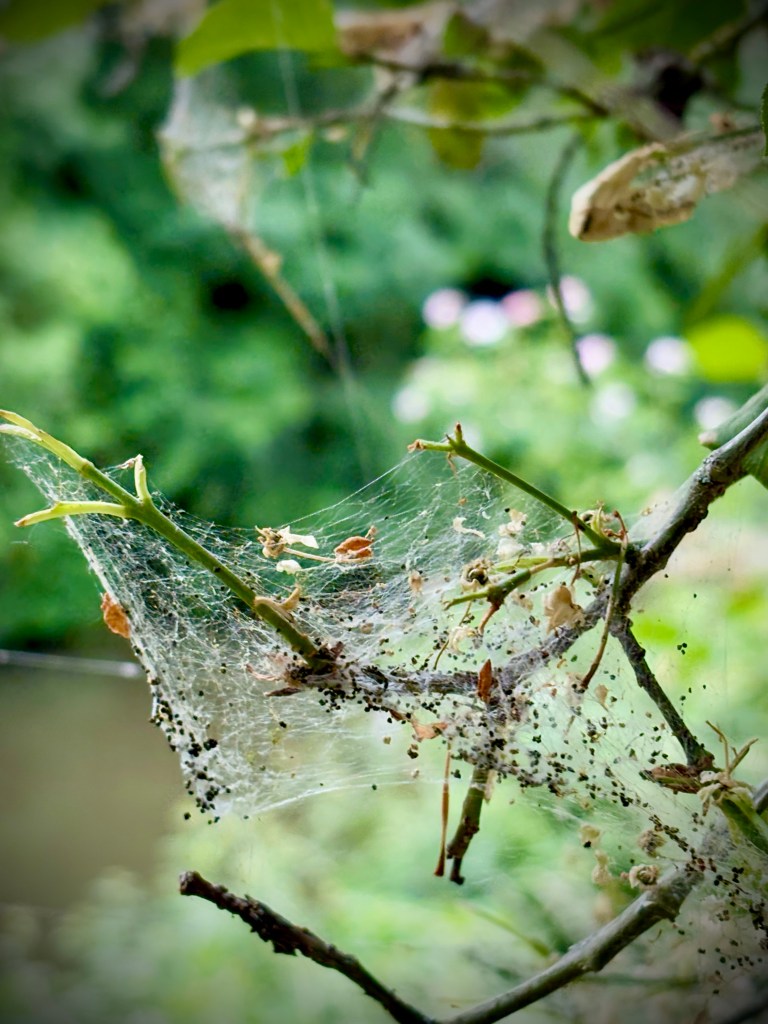
White campion – often used to be used as a substitute for soap and also as a remedy for various ailments. Good for pollinators.Web of Yponomeuta, or ermine moth.
_____
If you like what you’ve read, share it, tell a friend, or leave a comment. Thanks.
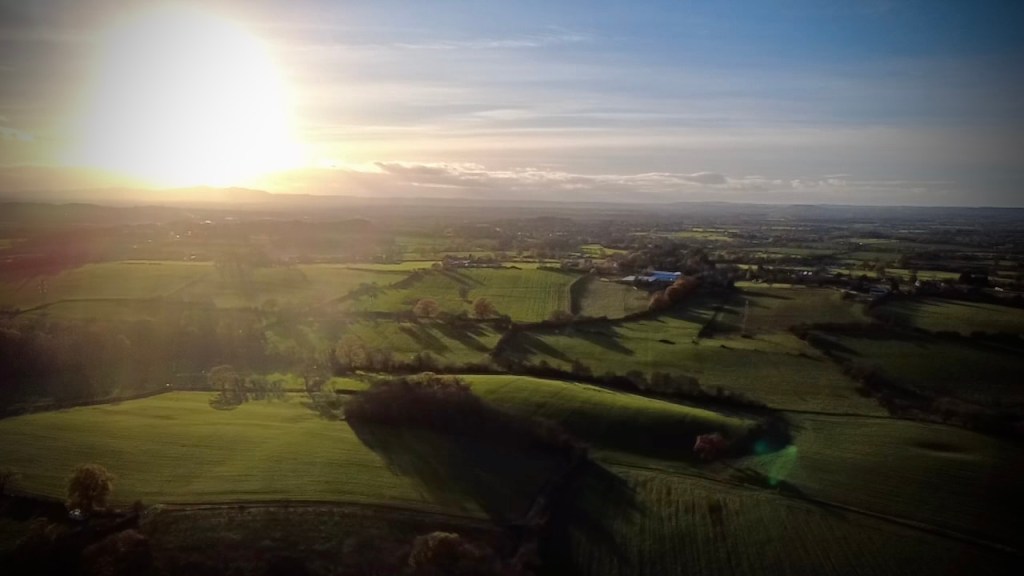
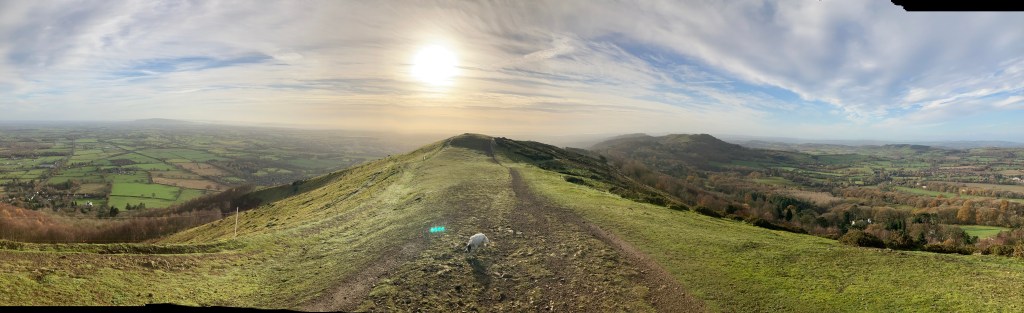
The photo on the homepage, and above, is of a place I return to time and again. From there, the land falls away on either side, revealing a patchwork of pleasant fields and hedgerows — Herefordshire and Wales to the west, Worcestershire to the east, and, on a clear day, the view extends as far as the Cotswolds and Oxfordshire.
This is the Malvern Hills. This quiet part of the British countryside has been part of my life for as long as I can remember.
Childhood and beyond, on the hills
My paternal grandmother used to take me there when I was little more than a toddler, back in the seventies. Gran and a friend in the front of her little Austin 1100, while the back seat would be crammed with four excited children, and a picnic stowed neatly in the boot.
We’d settle somewhere halfway up towards the Worcestershire Beacon, lay out the blanket and the sandwiches, and then launch ourselves down the grassy slopes on shiny, greased tin trays — coming to a calamitous halt in beds of bracken, amid shrieks of laughter.
Those halcyon days of childhood are etched forever in my memory.
Years later, as a teen, I would return to the hills with friends for late-night escapades involving alcohol and exotic, hand-rolled cigarettes. Late summer evenings, intoxicated and befuddled by herbs from the Golden Triangle, looking out over the lights of Great Malvern below and the rest of Worcestershire in the distance, trying to imagine all the history witnessed by those hills over countless millennia before my birth.
Looking towards the Worcestershire beacon, with paragliders circling.
A walk through time
These days, I walk the Malvern Hills with my dog. The views are the same, but somehow more meaningful. The wind still carries skylark song, and the bracken’s still in abundance. And though Gran has long since departed, she walks with me in spirit.
Those ancient hills — of Precambrian rock, tufted with bracken and moss, oak and ash — have stood sentry over this part of Albion for many millions of years.
Their spring water once filled Victorian spas, and quenched the thirst of the late Queen Elizabeth II. They are said to have inspired Tolkien’s White Mountains of Gondor, enchanted C.S. Lewis, and stirred the emotions of Edward Elgar.
And it’s easy to see why. Even the light here feels somehow storied.
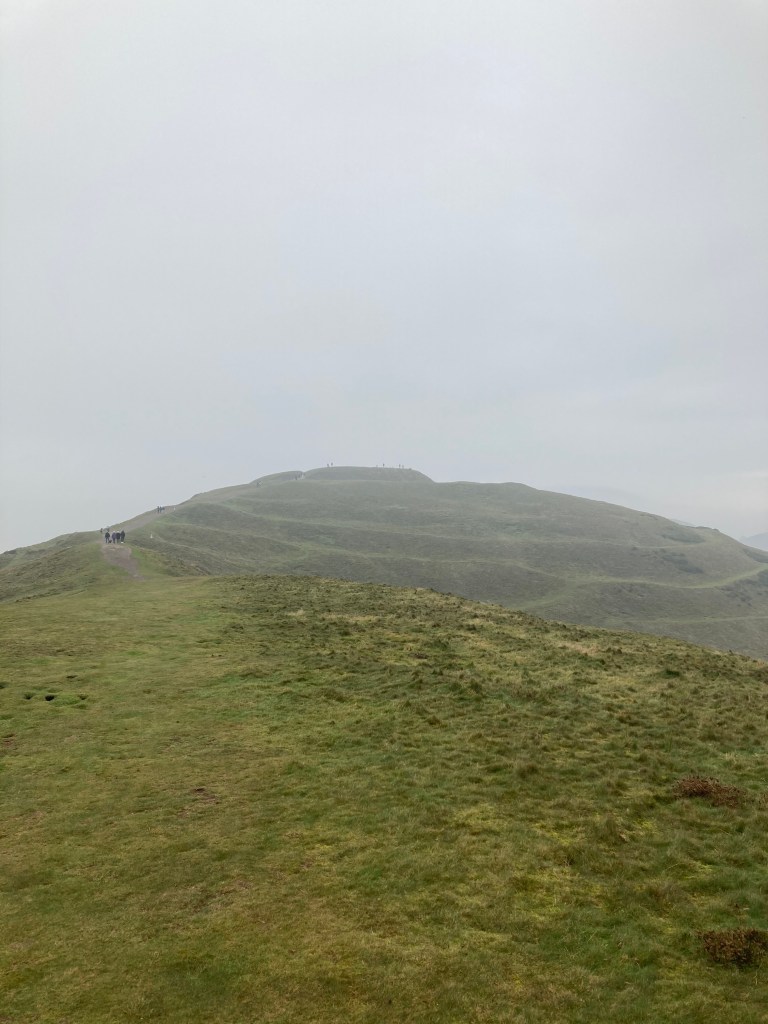
I like to imagine Elgar composing Caractacus while meandering the slopes of British Camp — the old Iron Age hill fort, which dates back to the 2nd century BC — as the wind breezed across from Wales.
Walking towards the Iron Age British Camp hill fort.
Why begin here?
Naturally, it felt apt to begin Notes from Foggy Albion from this high ground.
Despite many years living abroad and visiting a plethora of beautiful places, nothing I’ve seen evokes quite the same feelings in me as the sight of those majestic old hills. A place dear to my heart, and one that hums with local legend.
A landscape of larks and lore, and of tin trays and Tolkien.
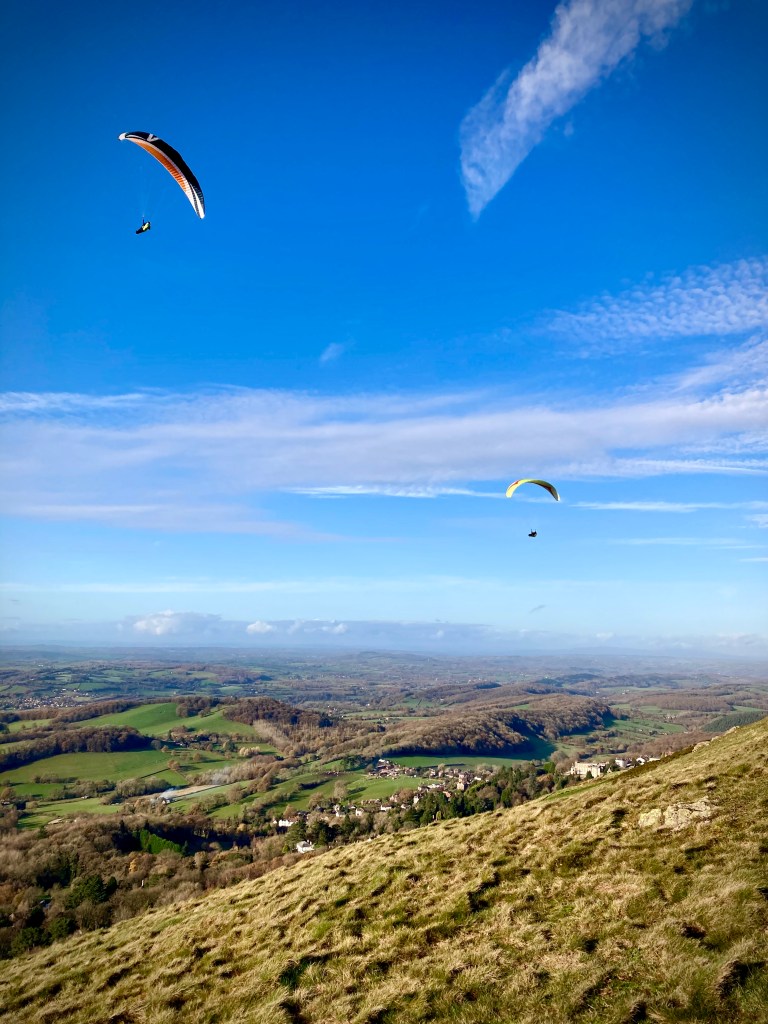
Paragliders enjoying the thermals, Herefordshire and Wales in the distance.
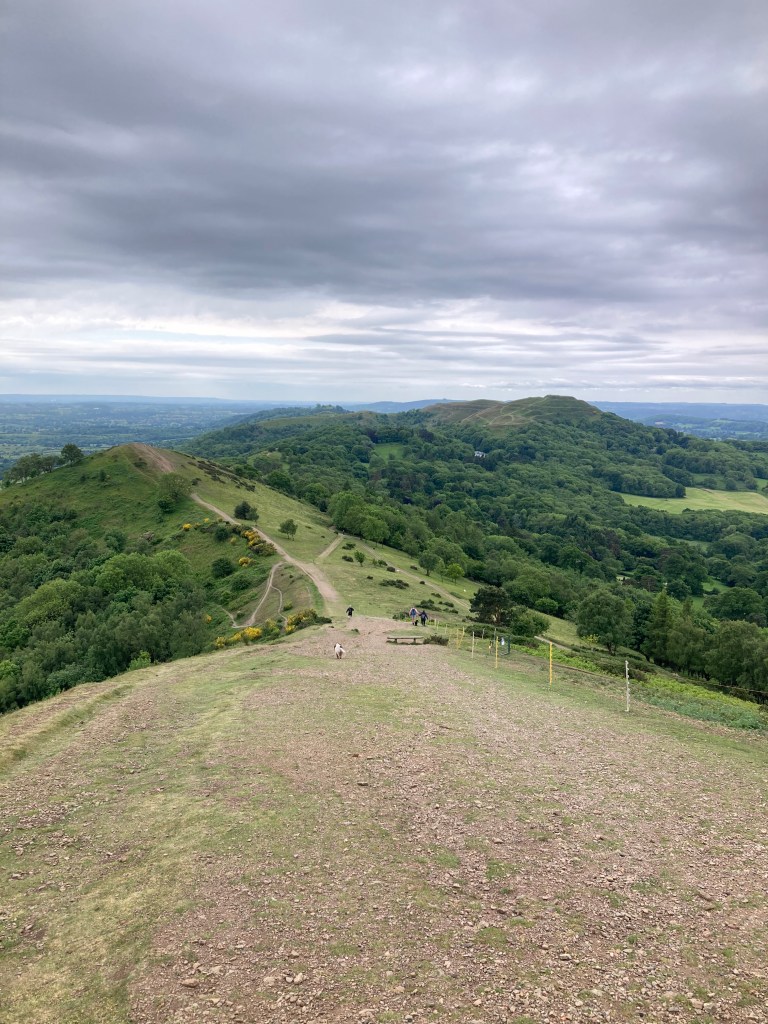
View walking down from the Worcestershire Beacon, south.
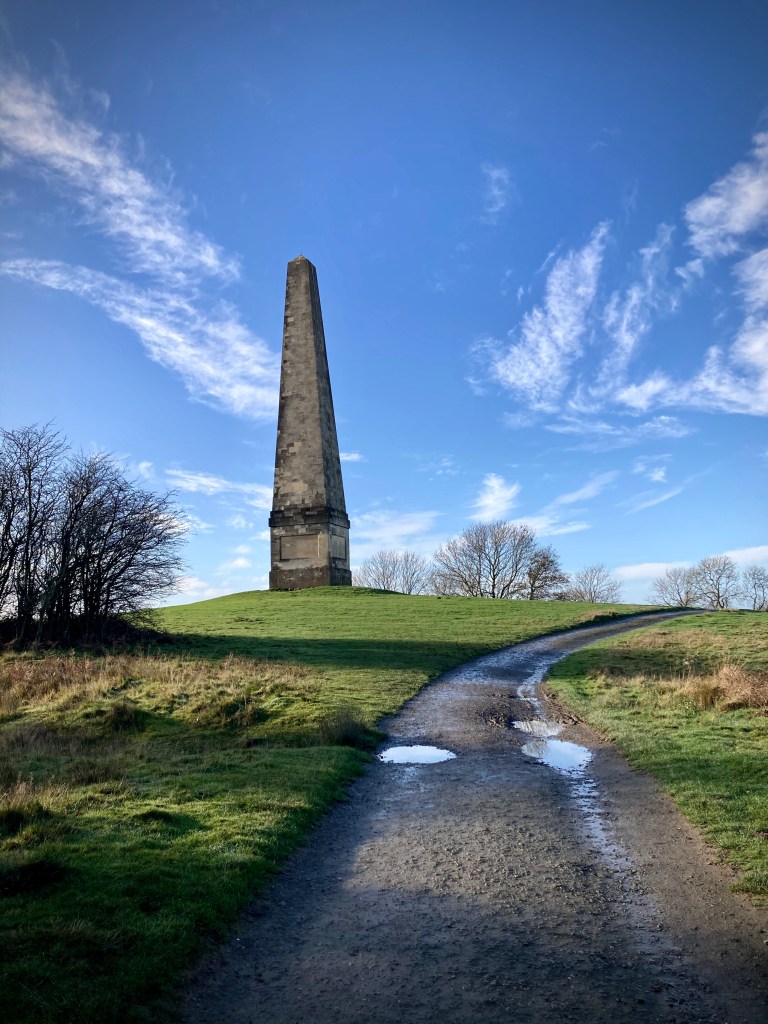
The 90 foot Eastnor Obelisk, erected in 1812 by the Somers Cocks family.
Thanks for being here. Let’s see where this takes us.


















 Notes from Foggy Albion: A Journey Through Nature & Plant-Based Living In Britain