

The lungs of the planet, important ecological habitats, vertical playgrounds, winter fuel or a canopy for youthful romance; the ever-important trees.
The Sycamore Gap tree is in the news again. After being illegally felled in an act of pointless idiocy and vandalism back in 2023, the two culprits have just been sentenced to 4 years in prison each. This got me thinking about our relationship with trees here in Blighty – and, I’m sure, in many other parts of the world.
Like most of my generation – that’s X since you ask – trees were a source of entertainment and joy whilst growing up. As kids, we didn’t yet have the mesmerising distraction of small screens, the internet and social media. Trees were there for everything; great for hide-and-seek, perfect for climbing, and where better to build a den or treehouse to escape the gaze of adults or from where to take refuge from imagined enemies?
Growing up in the countryside, as I did, trees were like vertical playgrounds littered across the landscape, waiting to be conquered. Repurposed wooden pallets could be hoisted up to create a ready-made platform high above the ground, and a base from which to build a den high up. Ropes slung over branches would be used as a swing. Fallen branches would be crafted into staffs with a trusty pen-knife, thinner ones into arrows and spears – this was the seventies and eighties, a time when the words “health” and “safety” were rarely heard together, or at all.
Trees have held great importance for these islands throughout history. With evidence of occupation going back almost a million years, broken by the occasional pesky ice-age which would, presumably, have destroyed most tree life on the parts of the island these ginormous kilometres-thick ice sheet would have extended to, we can look to more recent history. Assuming that Neanderthals and early Homo-Sapiens made use of what was perhaps an abundance of tree and plant life.
Evidence remains of Mesolithic and Neolithic inhabitants, through to the Beaker people of the copper-age and bronze-age Brits using trees to make tools, shelter and decorations. Celtic Druids of the iron-age had great respect for trees and their importance to humans. The word Druid apparently derived from the Celtic word for oak. Their natural oak groves were places of spiritual importance, for worship, education and knowledge transfer.
Wood, especially oak, became essential in the construction of houses, churches, cathedrals, and boats and then ships. As an island race, we have an affiliation with the sea. The earliest sea-going boat ever found in the world is widely considered to be the Dover Bronze Age Boat, found in Dover in 1992 and estimated to be 3,500 years old. It was made from oak planks.
Fast-forward to the 16th century and Henry VIII’s famous Mary Rose was built largely of oak. Lord Nelson’s iconic HMS Victory, built in 1760 from the timber of 6,000 oaks, not only played a huge part in the Battle of Trafalgar, but it is still in one piece today and remains, officially, a commissioned warship in service – the oldest in the world. It was oak that built the majority of the ships in the British navy, which was the biggest in the world from the 18th to the early 20th century.
The recognisable and much-loved Tudor houses of the sixteen hundreds, many still standing and lived-in today, including my own, were built around oak frames. The floors and furnishings were largely wood, often, but not exclusively, oak. Local car manufacturer Morgan Motor Company even made their cars’ body frames from wood, ash, and still do.
From the earliest shelters of the earliest humans through countless generations who’ve been kept warm by the side of hearths burning dried wood, to Dumbledore’s wand, wood has been part of British life.

The reverence and respect for trees seems as old as the desire to harvest them. Together, in groves and woodland and forest, it’s easy to see why the Druids felt they were of spiritual importance and sacred. Equally, alone trees can be towering, awe-inspiring and atmospheric. It’s not surprising the Japanese practice of shinrin-yoku, or forest bathing, is becoming increasingly popular.
Trees appear throughout our literature, history and legends and hold a special place in our hearts and minds: Enid Blyton’s Magic Faraway Tree in The Enchanted Wood, Hogwarts Whomping Willow, Sherwood Forest, the trees of Tolkien’s Middle-earth, the Hagley wych elm in Worcestershire, the Tolpuddle Martyrs’ Tree and the late Sycamore Gap Tree, to name just a few.
My own personal favourite were stories my late paternal grandmother would tell me as a very young boy during sleepovers about the, re-worked, adventures of Mary Mouse, who lived in one of the great old oaks that lined the bridle path running through part of our farm. I never once heard the conclusion to any of her adventures due to the soft and soothing way these tales were told, which set me to sleep within the opening minutes. But I do remember the tree was of equal importance to the mouse in those tales.
The older I get, the more I appreciate trees and their significance. Traditionally, the trees that line the brook along the my new woodland would be pollarded or harvested periodically for firewood. Now there is no grazing livestock in this section and no seasonal hay making and so, less need to keep things “tidy”.
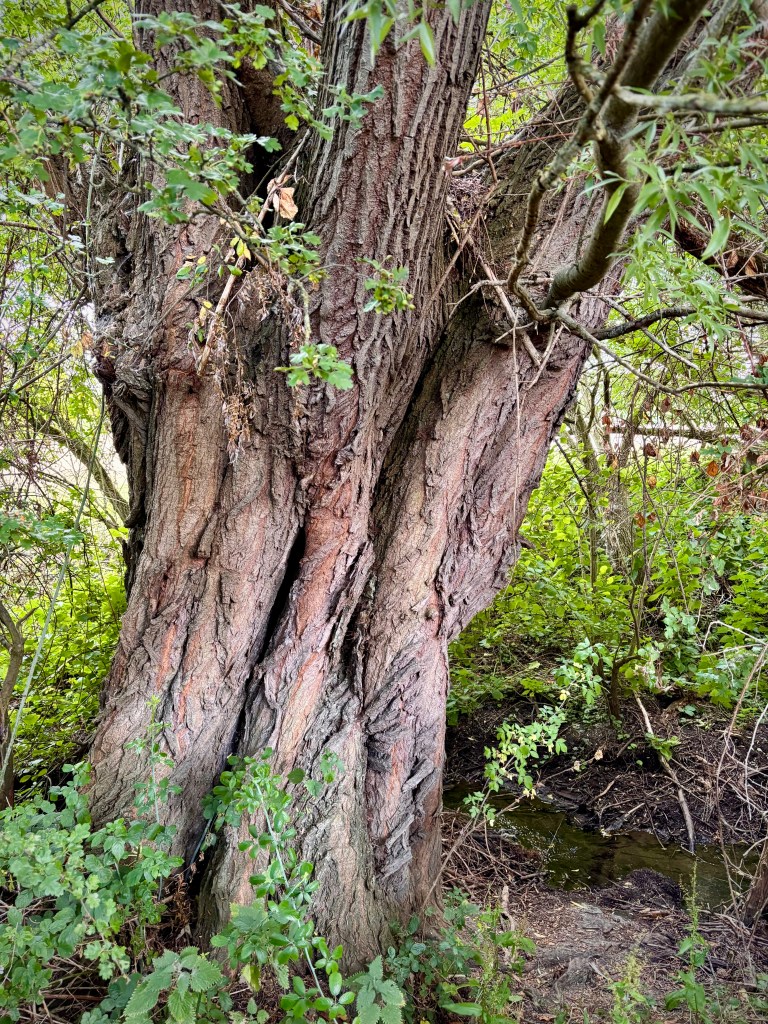
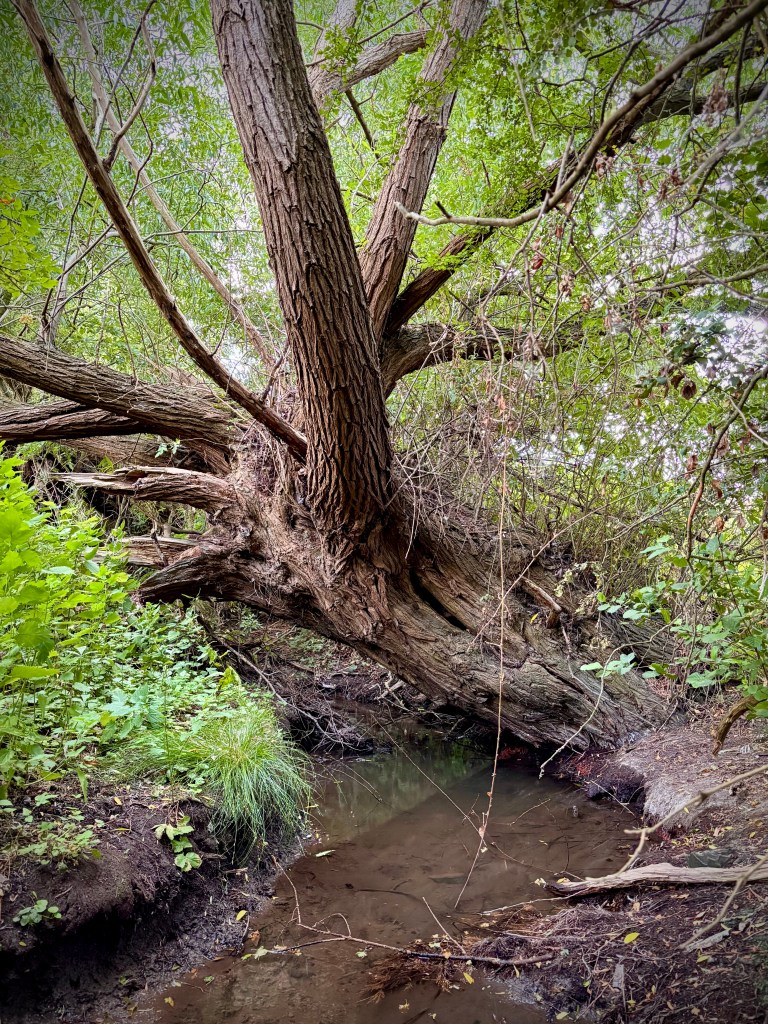
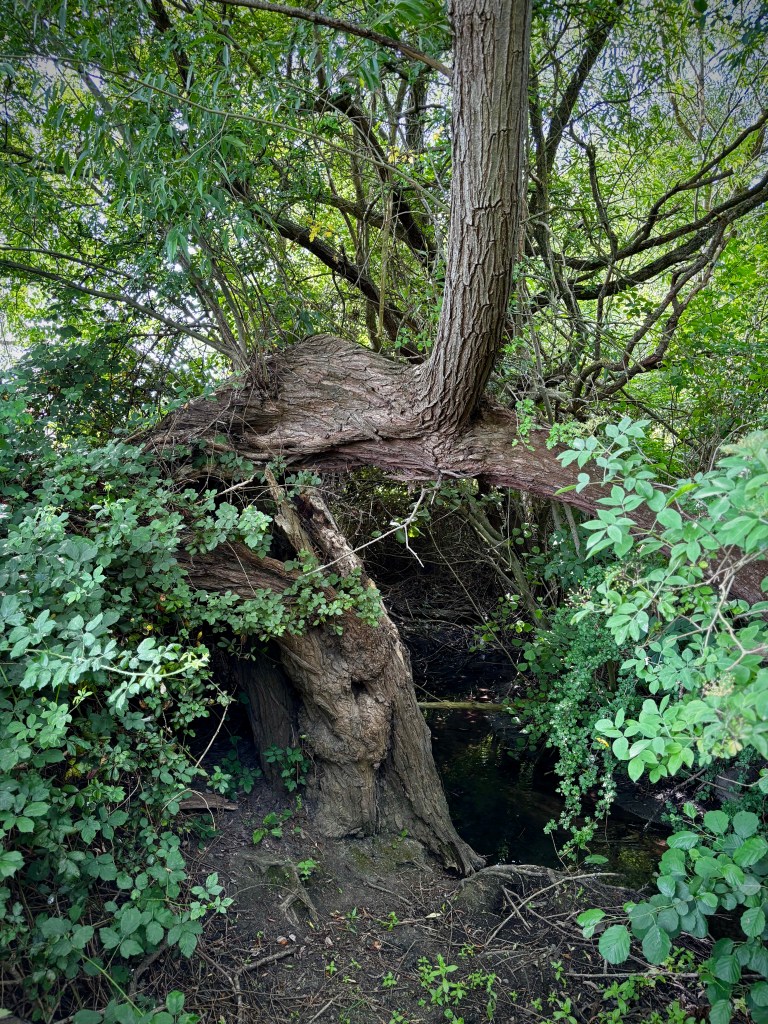
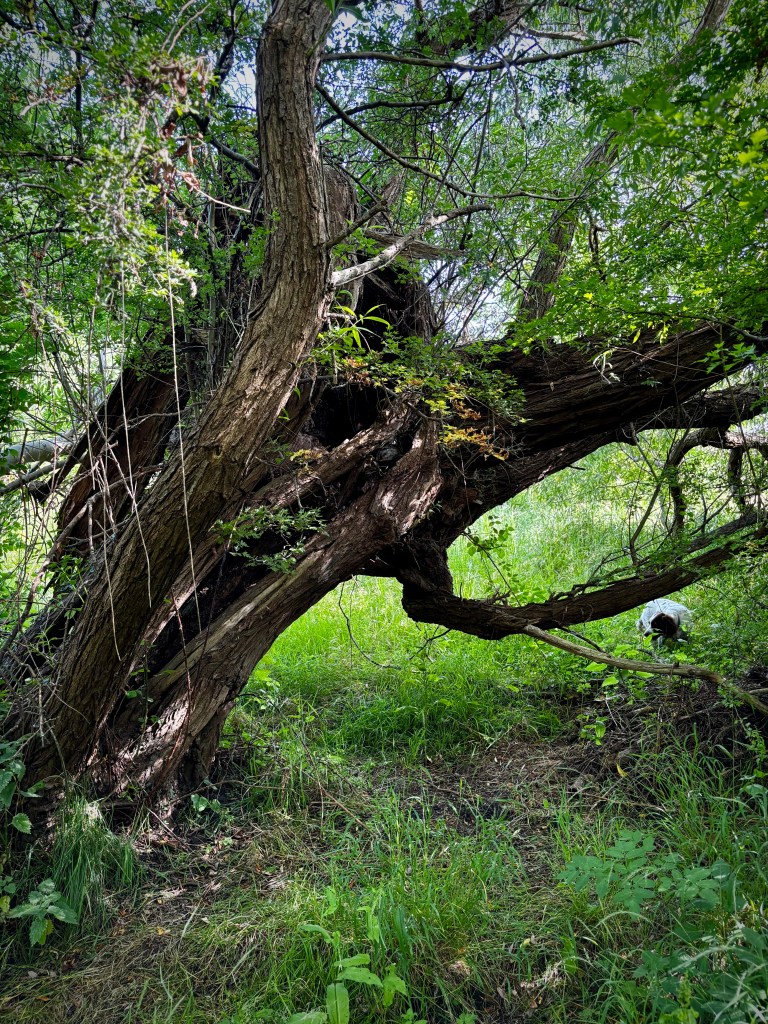
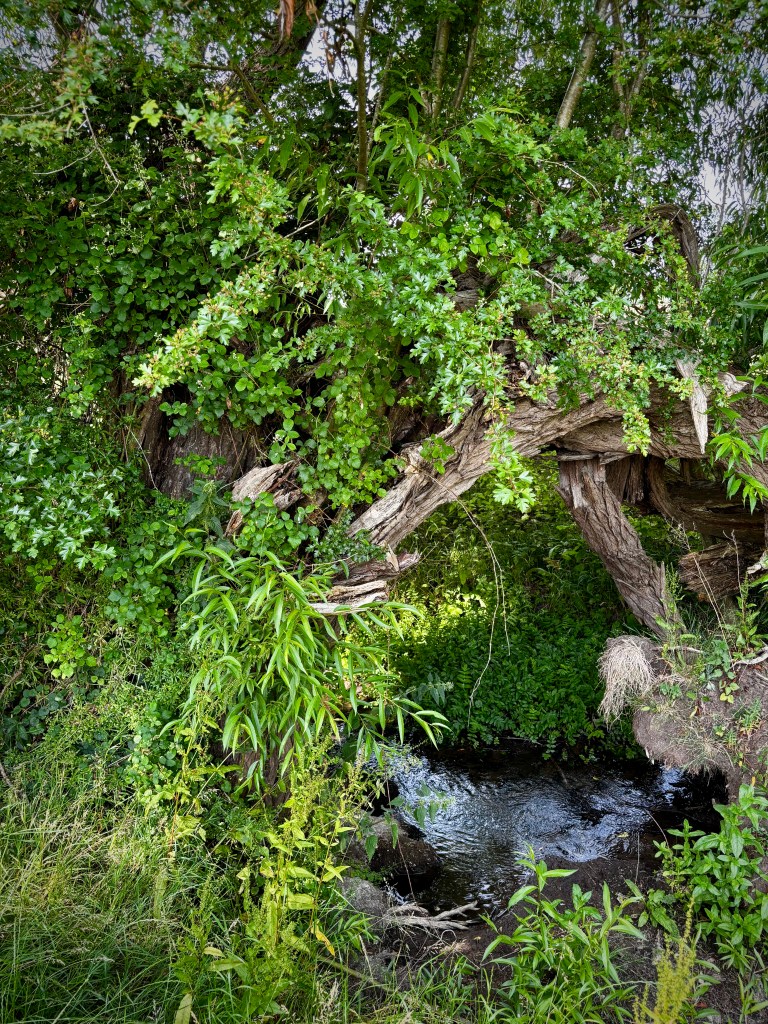
Over recent years, I’ve tended to leave some of the aging trees that have started to give in to the pressures of gravity as they age. As they naturally break down they create all manner of shapes and as they slowly deteriorate they take on life of other forms and become thriving habitats.
The brook is lined mainly with Salix (Willow) of one sort or another. These fast-growing moisture-loving trees become shape-shifters in their decline, slowly bending and twisting and splitting as they gradually return to the ground. Having resisted the temptation to take the chainsaw to some of these, they now provide a more interesting visual and are, arguably, better for the environment.
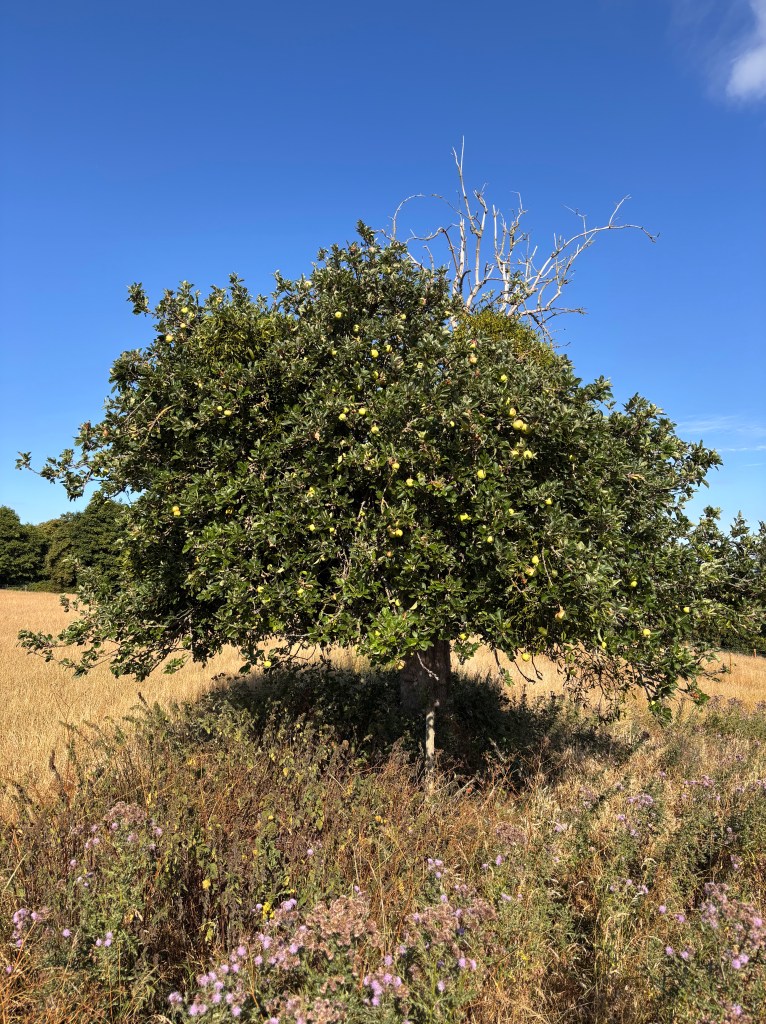
Alone on the highest point of the land is an old crab apple tree. These days, the fruit is usually devoured by birds and insects before I get chance to take anything from it and its aged branches are weighted more with mistletoe than apples – though this year I might be lucky. The trunk is almost completely hollow and a recent investigation by an ecologist found it to be home to bats.
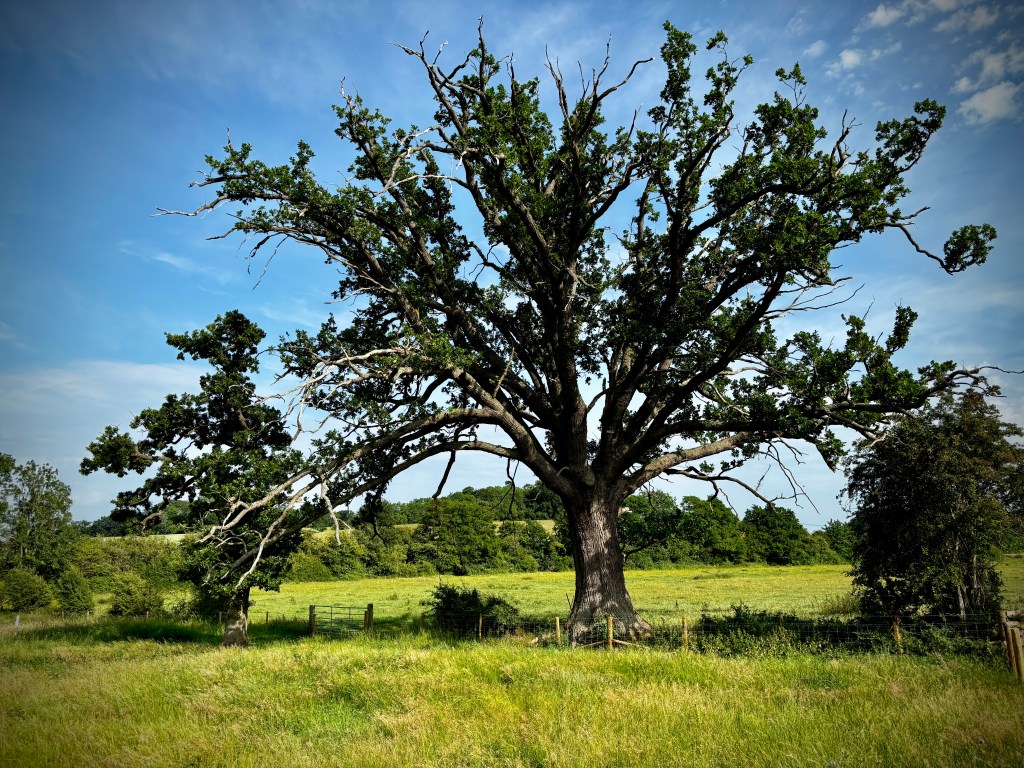
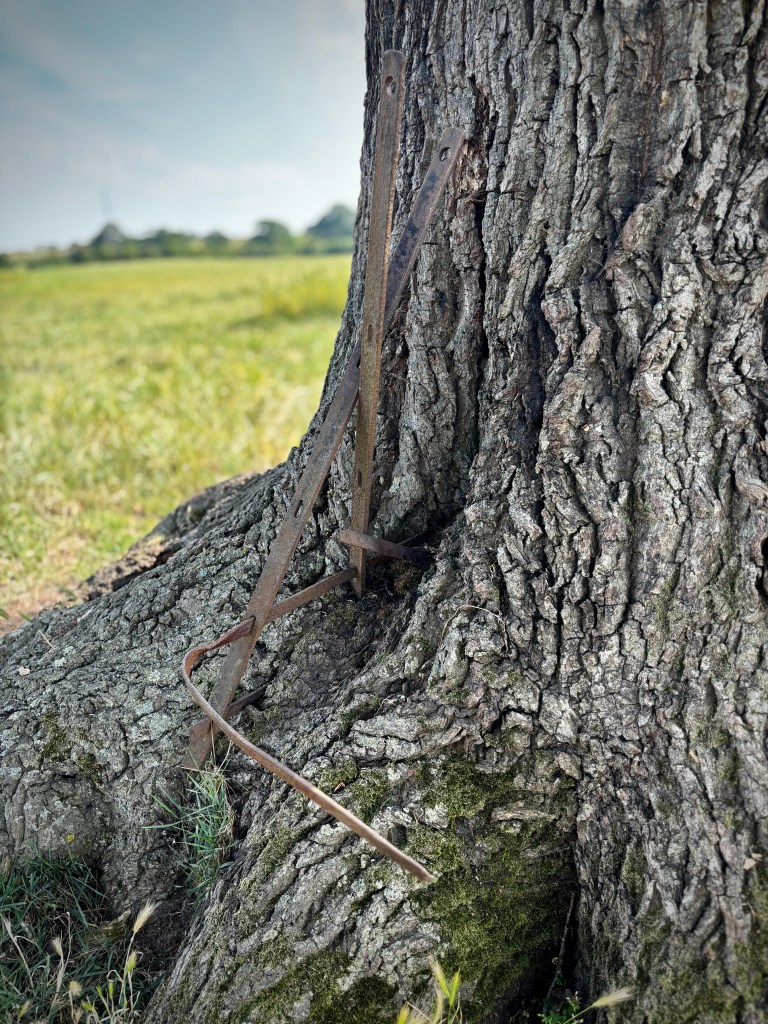
My favourite tree, possibly anywhere, is the great old oak that stands alone where once there was a hedge and estate fence. The hedge is now patchy at best and the only bit of the old Victorian wrought iron estate fencing that remains is that which the trunk of the oak has grown around and enveloped, taking it as its own.
According to a local ecologist, this tree is up to 500 years old. Like the land, it has been a constant in my life.
As a child, I attempted to scale its shear cliffs of bark. I swung from a rope swing suspended from it’s lower boughs. I camped beneath it on numerous occasions, and have done so recently whilst creating a wetland area. As a 10-year-old I had an old MOT failure, a French Simca 1000 (later replaced by a much better Triumph Dolomite), which I raced around the fields after harvest time, zooming through the gateway beneath this mighty oak, using it as a time marker. In my late teens, I engaged in romantic trysts beneath the shade of its vast canopy with girlfriends de jour, once being compromised whilst in such activity, completely “au naturel”, by a neighbouring farmer.
As the lower boughs succumb to the forces of nature and turn their direction of growth groundwards, the crown bears less vegetation than it used to. In springtime and summer, it resembles the head of an aged man with a thinning head of hair, almost perpetually in its autumnal season. Like all trees as they approach their final stages, this one is home to much life that is not tree.
Its hollow trunk is almost big enough to shelter inside, and there is evidence of it being home to various creatures of the wild. A bed has been crafted from dried vegetation and this room in a trunk has the aroma of animal, rather than tree – fox, pheasant, bat, hedgehog, rabbit, maybe all at different times. Looking up inside, decaying wood has formed like stalactites, pointed and cavernous, like looking up inside a cathedral tower.
Sitting beneath this majestic old oak, it is humbling to think of the centuries of history it has witnessed, and the changes that have taken place in the world whilst it has stood sentry in this part of Worcestershire. Assuming it is close to 500 years old, it would have been standing quietly here through the reign of Elizabeth I, the life of Shakespeare from neighbouring Warwickshire, the English Civil War, the collapse of China’s Ming Dynasty, the rise and fall of the British Empire, the Boston Tea Party and revolution that followed, the Industrial Revolution, the Napoleonic Wars, two world wars, the Cold War, Yuri Gagarin’s pioneering foray into space, then man’s further expansion to the moon and beyond.
So much has happened to the world and to us as a species, and this tree – like millions of others – has quietly endured. Rooted to its place on the planet, it has remained steadfast and silent, bearing witness to centuries of change. In an age of fast-everything, high-technology, and constant noise, maybe we need these silent, gentle giants more than ever. They purify the air we breathe, they provide food and shelter and support entire ecosystems, but, perhaps more importantly, they act as reminders of patience, resilience, and the quiet power of occasionally just simply standing still and observing.
 Notes from Foggy Albion: A Journey Through Nature & Plant-Based Living In Britain
Leave a comment